Friday, May 22, 2015

SGT. FRANK ZETTEROWER, JR.


STAFF SERGEANT FRANK R. ZETTEROWER, JR., 
Co. E, 2nd Bn., 222nd Inf.
42nd Division
UNITED STATES ARMY

“He Gave His Yesterdays For Your Tomorrows”


Awarded The Silver Star 
for gallantry in action at Gambsheim, France,
January 6, 1945


“Back in the States, we were told to
pick our squad leaders. One quality to look 
for was intelligence, so I picked the best.”

   Walter E. Stomski, Co. E,
   2nd Battalion, 222nd Regiment,
   42nd (Rainbow) Division, U.S. Army
 

                            ✯✯✯✯✯✯✯


  May 8, 1945,  V-E Day:  The Dublin Courier Herald’s banner headline read “ War Officially Ends.”  Public celebrations were somewhat subdued.  There were a few flags displayed publicly in stores and homes around the city.  In the Zetterower home, the mood was much more somber.  Dr. and Mrs. Frank Zetterower, Sr. had heard nothing from their son Frank, who had been reported missing in action for four seemingly endless months. Day after agonizing day, night after restless night, they held out hope.  Then on the day the war officially ended in Europe, the news they had feared, but prayed and hoped would never come, did come: “The War Department regrets to inform you that  your son was kil....”  You can’t imagine the pain, the never ending pain, unless you have been in their place. The families of James E. Fountain and Christopher Lowery got the same dreaded news that day, a day which was supposed to be a happy one.

Frank Zetterower, Jr. graduated from Dublin High School in 1936.  Little did Frank and his buddies, Red Tindol and Bob Werden , know what the world had in store for them in the upcoming decade.    After graduation, Frank worked a while for Swift and Company before he was granted a Dunlop Tire franchise in Dublin. 

Frank entered the United States Army and began his training at Camp Gruber, Oklahoma.  He quickly rose in rank to a Staff Sergeant in Co. E of the 222nd Regiment of the 42nd Army Division, known forever as the “Rainbow Division.”  The division got it’s name during World War I.  It was named by one of its members,

Gen. Douglas McArthur.  McArthur remarked that the division, which was originally composed of National Guard Units from 27 states: “The 42nd Infantry stretches like a rainbow from one end of America to the other.”  

One of Frank’s fellow staff sergeants was Sgt. George P. Beard, Jr..  Beard, Zetterower, and Russell Harris were the staff sergeants in 2nd Platoon, Company E, 2nd Battalion, 222nd Regiment of the 42nd Division.  Beard fondly remembered a humorous story about Sgt. Zetterower.  “Because Frank’s last name was Zetterower, he was well known by all of Company E.  There was a daily mail call.  The mail clerk’s name was Cpl. Gwaltney.  He proceeded to call out the mail by the alphabet each day. Frank, because of his last name, was always the last to receive his mail.  After a few
days of mail call, Cpl. Gwaltney, suddenly changed his procedures and started with the letter ‘Z.’   A lot of good natured grumbling occurred as Zetterower sauntered through the crowd with a broad grin and his mail in his hand.  Cpl. Gwaltney did this on several occasions and from then on, everyone knew Staff Sergeant Zetterower in Company E,” Beard wrote.
                     
S.Sgt. Beard remembered another incident which puzzled many members of the company.  First Sergeant Snow gave out weekend passes on every Friday. Sergeants Snow and Zetterower were always the first to get their passes to nearby Muskogee, Oklahoma.  After a few weekends, Beard finally asked why Snow and Zetterower always got their passes before anyone else.  Zetterower reluctantly revealed that he and Snow were studying to obtain their degrees as Masons in the Muskogee Masonic Lodge.    Because of Frank’s inspiration, Beard became a Mason and recently received his fifty-year pin from Culpepper, Virginia Masonic Lodge.  

After basic training, the members of the 42nd Division, composed of the 222nd, 232nd, and 242nd regiments, boarded troop trains on November 13, 1944 bound for Camp Kilmer, New Jersey.  The men wrote their families with the traditional sentiments directing them “not to worry, I’ll be back home, soon.” The men marched quietly to the long train of Pullman cars and troop sleepers as the band played “The Rainbow Song” and “Mountain Dew.” Their wives, girl friends, and well wishers
cried.  Despite an attempt to disguise their mission upon the arrival at Camp Kilmer, everyone knew that they were bounded for Europe.  Many of them had been told that the war was almost over and that the German army was ready to quit.  Upon their arrival in New Jersey, the men caught up on their sleep, contacted their love ones and wondered when they would get a pass to New York City.  Most of the men got to go to the “Big Apple,” before all passes were canceled and they were restricted to the base.   From there, the men of the Rainbow Division boarded the troop ship,
“The George Washington,” bound for France.  The rest of the division would come over several months later.
                 
The infantry regiments of the Rainbow Division arrived in Marseilles, France on December 8th and 9th.  Shortly after their arrival, the men marched to a stony, windswept piece of ground known as Command Post 2.  The weather there was an omen of things to come.  The days were cold - the nights, even colder.  The men continued to train during the day.  All lights were put out at night  to protect against German air raids.  In one of his last letters to his brother John, whom Frank affectionately referred to as “Mug Head,” Frank said that he was about 350 miles from the front, somewhere in southern France.  “I don’t know how long I will be at this place, so I’m just waiting around with everyone else to see what happens,” Zetterower added.  The first news from his wife Zona since his arrival in Europe comforted Frank.  Frank wished John, who was a Lieutenant Junior Grade stationed at Dental Dispensary # 29, Camp Ward, U.S.N.T.C., Farragut, Idaho,  a “Merry
Christmas and Happy New Year!”  The Battle of the Bulge dominated the news from the front.  The Third Army was moving northward, while the Seventh Army was stretching its thin lines to take up the line vacated by the Third Army.  The Rainbow Division was assigned to the Third Army and left the Command Post in trucks, and 40 and 8 boxcars to an assembly area in Bensdorf, France.  While they were on the way, the division was reassigned to the Seventh Army to relieve elements of the 36th Division around Strasbourg.
                                   
The 42nd, not a full strength division, was assigned to Task Force Linden, which was under the command of Brigadier General Henning Linden and which assembled near the ancient city of Strasbourg, where they arrived on December 23rd.  On Christmas Eve, while the remainder of the Division was still preparing to come over, the 222nd regiment moved into front-line defensive positions along the Rhine River.  Task Force Linden was  placed under the control of the 79th Division.   The 232nd Regiment was on the left flank, the 222nd situated in the city of Strasbourg, and the 242nd sat on the right or south flank.  The total line stretched for 19 miles.   The 42nd spent Christmas on the Maginot Line housed in old French forts and school buildings.  There was hot turkey dinner that day.  There was even running water. Frank and his men could look and see the famous Gothic Cathedral which towered above the skyline of Strasbourg.    Bill Clayton remembered seeing the German soldiers moving about on the other side of the river.  They had orders not to fire,
unless they were fired upon first.    The Germans, also on the defense, fired occasional volleys of machine gun fire into American positions.

    Following the Battle of the Bulge, German forces under Himmler were determined to repulse the Allied advance into their homeland.  On December 26th, American generals were desperately seeking to fill gaps in the Allied lines. Contingency plans for the evacuation of Strasbourg were laid out.  American lines grew dangerously thin.    New Year’s Day found the Americans shifting positions again.  The 222nd regiment took over the sector previously occupied by the 242nd regiment south of Strasbourg.  A threat of an attack on the following night sent the 222nd a little further to the east.  Following a conference between British Prime Minister Winston Churchill and French leader Charles De Gaulle, a decision was made to hold Strasbourg.  January 3rd was a bitterly cold day.  Frank had previously written his brother stating that because of the extreme cold in France, that he and his men were forced to burn their shoe polish to stay warm.   Refugees, fearing an oncoming battle, were fleeing  Strasbourg.  The 2nd Battalion of the 222nd, including E Company, moved back into Strasbourg.

E Company (222nd) was relieved on the 5th of January, 1945 by soldiers from the 1st French Regiment.  In order to speed up the relief, one company at a time was taken out from the lines.  By 1:00 p.m., E Company had been completely relieved and the men began loading their trucks for Wantzenau.  They rode in trucks known as DUCKs, which were amphibious vehicles. Company leaders had no knowledge of their mission once they arrived in Wantzenau, when they were directed to move to Weyersheim.

The Germans noticed the movements of the 42nd and began an attack on Gambsheim and other points along the Rhine River on the morning of the 5th.   At three o’clock on the afternoon of January 5, 1945, Lt. Colonel Edmund Ellis received orders for the attack on Gambsheim, France, a small village along the Rhine River, which separated France and Germany.   It would be the second time in a month that American Forces attempted to seize the French border town.    On December 7, 1944, three years to the day after America’s entry into the war, the 19th Armored Infantry battalion and the 25th Tank Battalion liberated Gambsheim.   Zetterower’s company was ordered to move from west to east along the south side of the Weyersheim - Gambsheim Road with E Company of the 232nd Infantry in the attack echelon.  The two companies were a part of Task Force A commanded by Ellis. They were to attack Gambsheim from the west, while Task Force B would attack from the south. The two forces began their attack two to three hundred yards west of Weyersheim with Co. E (232d) moving on the right flank south of the Weyersheim - Gambsheim Road. Zetterower’s company  was still on the way from Strasbourg.  As darkness began to fall, three supporting tanks took the point. Ellis’s force encountered little resistance, only light arms from German patrols slowed the advance. Once E Co. (232d) reached the edge of town and the cover of the Steinwald woods the fire intensified.

The leading elements of Ellis’ force found that a German force had moved into the Steinwald woods, north of town.  The briefing the men received earlier stated that there was no information  whether there were men in the woods or not.   Other German outposts were established along the Landgraben Canal west of the woods. When contacts with other elements of the Task Force were lost, Ellis called a halt to the advance and returned back to the Landgraben Canal.  The men dug in while the leaders continued to attempt to contact the 2nd Battalion of the 242nd Regiment, which had been delayed in coming up because of heavy enemy fire.  At six o’clock in the evening, the two Task Force leaders, were discussing their next move from a command post in Weyersheim.  

Company E arrived in Weyersheim about 4:30 p.m.  They were told little, just that a small force of Germans were defending the town of Gambsheim.  E Company (222nd) was told that the attack was in progress and that they would be the reserve company in the attack, 600 yards behind E Company (232nd).   As the Company Commander was returning to town, the company had already dismounted from their vehicles and were moving forward through Weyersheim.  During their advance through the town, the commander ordered a test of the radios.  Only two of the six radios had been calibrated. Two quit working after ten minutes.  In the haste to move out quickly, the bazookas and bazooka ammunition was left behind in the supply truck.
 
Upon their arrival at the canal, Company E (222nd) was ordered to assemble in a field. “There were many junior officers, non-coms, and platoon runners there,” Clayton remembered.  The men removed all but their most essential gear.  Each man placed two hand grenades on his field jacket flaps.  They loaded as much ammo as each man could carry.  A first aid kit and a canteen was the only other equipment that most of the men would carry with them - a thought which befuddled Clayton who was told to expect tanks along the way.  The Company Commander went to look for the battalion commander and placed a platoon leader in command of the company.   The captain ran into the tank commander, who had not seen anything of E Company (232nd).   When he returned to his company, the captain found that E Company (222nd) was about 400 yards west of Gambsheim, out in front of E
Company (232nd).  The captain ordered an immediate withdrawal back to the canal.

The Battalion Commander ordered Zetterower’s company to form a defensive perimeter west of the canal in the rear of E Company (232nd).   “ The ground was bitterly cold, the ground was covered with snow, and we huddled together all night long trying to keep warm and prevent frostbite, ” remembered Sgt. Gareth Tuckey. Many of the men slept (or tried to sleep) out in the open with little to warm them. After a reconnaissance patrol returned to camp, the Battalion Commander ordered Zetterower’s Company to be the attacking company, when the force crossed the bridge on the next morning.  The vehicle bridge was the only place where the canal could be forded.  The companies were ordered to get into files and to follow the 242nd over the bridge.

At 3:00 o’clock on the morning of January 6, 1945, the Ellis force departed from the departure point, the Landgraben Canal vehicle  bridge.  Their mission was to reach the railroad station before eight o’clock.  This time line was critical because the ground between the bridge and the railroad was flat and open.  After reaching the railroad, the Ellis Force was ordered to push the German’s across the Rhine River.  This was no easy task for two companies which had virtually no armored support.

In an interview following the battle, Colonel Ellis stated, “The attack went off as planned.  The tanks moved out with the Ellis force.  The terrain which the 2nd Battalion, 242nd Infantry, was advancing was not suitable for tanks.  The attack progressed in a satisfactory manner.” He further added that “basically the plan for the attack was sound, but that a three hour delay for further reconnaissance and
organization would have been of considerable benefit.”  Better communications, ammunition resupply,  and additional fire support would be needed for the attack to succeed.  There was no bazooka ammunition, although each unit carried an adequate supply of bazookas.  

The point of the 242nd was cut down by fire which enfiladed the column.  Two tanks were brought up to lead the advance.  The forces then moved out across the bridge and took up night attack formations.  Bill Clayton remembered that “you could only see a few feet and conversation was limited to a few whispers.”  The attack pattern was two or three men on the point, followed by the company commander, who was followed by three platoon runners, and three rifle platoons.

Heavy machine gun fire began to rain down on the Ellis Force after they crossed the first canal. Three 60mm mortars silenced the machine guns.   Clayton remembered that the German machine guns opened up from several directions. Sweeping tracers were flying all over the place.  Clayton thought about lying down in the snow.  He heard S/Sgt. Boyd Turner cry out that he had been hit. Clayton crawled to Turner and brought him back to safety behind a pile of rocks or a stone wall.  It was hard to tell in the dark of night.  Company E, with Sgt. Zetterower heading one of the leading elements, began to race across the open ground, firing as they ran.  The dark night allowed Ellis’s men to move faster.  The Weyersheim-Gambsheim Road, which divided the two forces, aided in directing the attack toward Gambsheim.  The flashes from German guns in the Steinwald Woods to the northeast kept the men moving in the right direction.  The skirmishers of the  242nd slowed the enemy fire from the Steinwald Woods.

As Lt. George Carroll of Company E looked around as the nautical twilight began, he noticed that the tanks which had been promised to him were not there. He ran back in the dark to find them, but to no avail.  E Company was pinned down in the snow.  They were easy targets.  Men were being wounded and killed, left and right, in the crossing machine gun fire.  Charles Livingston, a platoon leader, looked around and saw no one was firing.  Company F was supposed to be coming up on the
right flank.  They were not there - ambushed and pinned down by the Germans several miles away.   The men of Company E  were hugging the snow laden ground. Still, there were no tanks.  Five runners were sent back to find them.  All five were wounded.  Frederick L. Vonglarick, Kenneth Dickey, and Harry D. Pratt were all awarded Bronze Stars for their heroic achievement in volunteering to run back through the fire to find the badly needed tanks.  All three were wounded and were presumed missing in action.   As Carroll approached riding on one of the American tanks, Livingston ordered his men to charge toward the railroad embankment. The tanks stopped and began firing.  One round accidentally killed two men and wounded a platoon leader.  The Company Commander attempted to force the tank to unbutton its turrets by beating on the turret with rifles. 

After this didn’t work, he managed to get in front of the tank’s periscope and waved his arms.  By 8:00 a.m., the tanks were no longer to be found.  The tank platoon leader was killed when a bazooka round destroyed his tank.

The men charged toward the railroad tracks.  They had only crossed half way across that open, and very deadly, field.  There was no alternative.  One officer ordered his men to fire rifle grenades into the railroad station.   There were rebel yells and shouts of “hubba hubba” as the men rushed the German positions.  By this time, most of the men must have felt they were about to die.  The embankment of the tracks was the only cover from the horrific fire they could find.   The tracks, which were elevated twenty feet high at a 100% slope, provided excellent cover.  The rifle grenades seemed to slow the enemy fire coming from the station.   Livingston said, “the last time I saw Frank, we were pinned down in the snow along the railroad tracks.”  

It is impossible, after 55 years, to determine the exact order of events as the battle as they took place. The men’s memories are clouded by the maelstrom of the moment.    Frank took his 2nd Platoon rifle squad toward an open school yard.   “He was with the leading elements of the company,” said Sgt. Gareth Tuckey,  who lead a weapon’s platoon in Zetterower’s rear.     Suddenly one of Frank’s men was wounded, lying helplessly  in the open.  The sun was quickly illuminating Zetterower and his men, who were silhouetted against the white snow.   Frank had to do something.  His man had no chance out there.  Someone had to go get him.  He knew the odds weren’t good.  That man would die unless he went to out to get him.  The sergeant made sure his men were covered from enemy fire before he made his move. He made it to the man and began to drag him back to safety.

Small arms fire and the always deadly automatic weapons fire permeated the school yard.  The shots were coming from the direction of the Gambsheim railroad station.  Charles Ross, who was standing near Sgt. Zetterower, said  “ he just dropped down and his helmet went flying back off his head.” Ross called out to Frank, but Frank never moved or answered.  When Lt. Carroll ordered the men the charge, Walter Stomski stood up.  He looked up and down the lines.  “I was horrified to see how many of us did not get up,” Stomski lamented.  Stomski called for his squad leaders looking for orders. “When I called for S. Sgt. Zetterower’s name, he did not respond,” Stomski still vividly remembered.  “At this point, I knew he didn’t make it, but it was not confirmed until the next day when the medic reported the casualties to me,” Stomski said.

The men were ordered to keep going.  Ross hoped Frank was just wounded. Weapons platoon leader William C. Bahan and Sgt. Gareth Tuckey followed Frank’s squad into Gambsheim.  When they got to where Frank was, they found that someone had marked his location by sticking his rifle into the ground and placing his helmet on the ground.  There was nothing they could do for him now.    They said to themselves that at least he did not have to suffer very long in the extremely cold weather. Rear elements of the unit came up and brought Frank’s body back to the back of the lines.  Sgt. Zetterower was the company’s first casualty of the war-  in its first battle.

Rifle grenades drove the German defenders from the railroad station area. Fortunately there were no German troops in the railroad station, which Livingston set up as a command post.  Company E of the 232nd Infantry, the reserve company, came up and the survivors established a shaky foothold on the western edge of town.  E Company (232nd) had lost all but one of its officers in the first hour. Then, inch by inch and foot by foot, the Americans moved house to house, eventually making it to the eastern edge of Gambsheim.  The Gambsheim Church was shelled in order to prevent sniper fire. The plan was then to take the southern half of the town.  E Company (232nd) took over the attack echelon.  E Company (222nd) had used most of its ammunition.  The 2nd Platoon was used to establish a bridgehead.  The 1st and 3rd Platoons moved out toward Gambsheim Church, which they took fairly easily through the use of rifle grenades.   The 242nd, now north of the town, had no support.  Col. Ellis reported that there was little fire in the town itself, although there was some enemy artillery shells fired, but were being shot over the heads of his men. Had Ellis known of the predicament of the 242nd, he would have turned north, instead of south.

The Americans had been told that the town was occupied by a few war weary German infantrymen.  Instead, they ran into a company of German Panzer tanks. With no bazookas, the infantrymen of Task Force Linden were helpless.    Then men originally thought they were American tanks coming down the Rhine River from the flank.  The men noticed that behind the tanks were German infantrymen, many of whom were killed by American machine gun fire.  

Sgt. Frank Diaz, Jr. was wounded in his back by mortar shell fragments.  Diaz continued to assist the squad leader until he was also wounded.  Sgt. Diaz took command of the squad and helped move the wounded into a railroad station.   Diaz remained with the wounded and took them down into the basement and then directed the remaining men out of the station and back to safety.  For his actions of heroism, Sgt. Diaz was awarded the Silver Star.   Ross was wounded in the leg and taken to an aid station, which had been set up in that  house.    Someone came in and told him and four other wounded men that the companies were pulling out and they had to stay behind. The five wounded men hid in the basement of the house for five days until they were captured and taken to a German P.O.W. Camp for the remainder of the war.  They never knew what happened to their friends and fellow members of the company.

Bill Clayton remembered coming to after being hit by something.  He was directed to a pub where medics were treating the wounded.  The lesser wounded men started passing a bottle of Cognac around to help alleviate their painful wounds. Then someone yelled, “here comes a tank!”  The tank fired a shot directly into the building.  Those who could run,  ran out. Clayton attached himself to a Lt. Colonel, whom he figured knew what was going on.  The colonel was trying to organize a delaying action to stop the tank.  Clayton made it back but, it wasn’t easy.

Sgt. Tuckey’s weapon’s squad made it to the station “where it seemed obvious to me that we were hopelessly out-gunned and out-manned, Sgt. Tuckey wrote.  “A couple of senior officers sent three volunteers to try and locate the armor support. They were wounded or captured almost immediately,” said Tuckey, who then was forced to withdraw with the rest of his squad.  “I lost five men from my platoon, including a college classmate, who was my best friend,” Tuckey lamented.

There was still no communication with the 242nd on the north, or more importantly, the 232nd on the south.  Ellis’s men thought they could hold against the infantry, but not against the powerful Panzers.  Ellis ordered a withdrawal.  The Germans failed to pursue them.  Ellis commented that the German infantry was “rather inferior.”    The two companies of Ellis’s force joined west of town, but when heavy mortar fire began coming into their positions, Ellis ordered a further withdrawal.

The survivors made it back to the Rohr River to the west.  Livingston and some of the men escaped under the cover of a frozen irrigation ditch.  In all of the confusion and pure Hell, Livingston was unaware of Zetterower’s condition. Livingston, who was awarded a Silver Star for his heroism during the battle, was shocked and grieved, nearly fifty five years after the incident, when he first learned of Frank’s wounding.  He was “a truly likeable guy,” Livingston said.  “Frank amused me with his ‘Yankee Californian’ pronunciation of his name, which sounded like ‘Zettawowah,” Livingston fondly remembered.

The American forces had been  forced to into a hasty withdrawal, having to leave many of the wounded behind, including the platoon leader, 2nd Lt. Dallas Hartwell, the third platoon leader,  and Sgt. Zetterower.  It was their first “baptism of fire.”  The two task forces dug in and waited for eight cold days before being sent back to Luneville, France to recuperate and accept replacements.  The men recovered, new replacements came in, and the advance toward Germany continued. Company E saw action three weeks later at the Ohlungen and Hagenau Forests.   In the last weeks of the war, the men of the 42nd Division moved in the concentration camp at Dachau.   Not knowing  whether or not they were going to fired upon they moved into an area which Bill Clayton described as “deadly quiet.” The prisoners were huddled in their cages. No words were uttered.  Those men of the 42nd, who were the first to enter the camp, were profoundly affected by what they saw for the rest of their lives. The war ended when the 42nd Division was near the Bavarian Alps, which was some of the most beautiful country in the world, a substantial contrast to the hundreds of mile of Hell that had traveled in the last five months. 

Going into the battle, Bill Clayton estimated there were 175 men in Company E.  After the battle the company’s strength was down to 65, including the walking wounded.   Among those who gave their lives were Pfc Dominic R. Deluca, Pvt. Jack E. Hodge, Pfc John T. Ratchek, Pfc Robert W. Swanson, and S/Sgt Frank R. Zetterower.    2nd Lt. John T. Smithson was awarded a Bronze Star for his heroic
action, when his company was pinned down by heavy machine gun fire, mortar fire, and small arms fire.  Lt. Smithson rallied his platoon and laid down a covering fire which permitted the advance to be continued.  When many of his men began to fall, he succeeded in having two of the more seriously wounded men moved safely to the rear.  Lt. Smithson was reported missing in action following the battle.  Pfc John Masonis was also awarded the Bronze Star for heroism when he came out from the
protection of a wall and fired his Browning automatic rifle to allow several exposed men to crawl to the safety of the wall.  Masonis disregarded his wounds and once again moved out into the open to give aid to his wounded platoon leader.

          “On January 6, 1945 at Gambsheim, France, Company E, 222nd Regiment received its baptism by fire.  Without artillery or armor support, and without proper weapons to destroy enemy armor, we attacked the enemy.  We got our asses kicked, losing over half the company.  It was a strange tactic to say the least.”
         
          Bill Clayton, Co. E, 222nd Infantry


     In the fall of 1945, the United States Government recognized the heroic achievements of Staff Sergeant Frank R. Zetterower, Jr.  Major Gen. E.F. Witsell posthumously awarded the Silver Star, the nation’s third highest award for heroism, to Frank’s widow, Nona, in recognition of “ His skillful leadership and self-sacrifice in taking care of his men and for gallantry in action.  Frank’s body arrived in Atlantaon July 21, 1948, just over three and one half years following his death.  On that very day and after a long illness, his father, Dr. Frank R. Zetterower, Sr., died.  Both were buried in Northview Cemetery in a double funeral (Sect. M, Row 1).
     
      Ten days after the death of Sgt. Frank Zetterower, another young Dublin sergeant  was a mile or so west of Gambsheim.  He was a part of the 66th Armored Infantry Battalion.  His unit was involved in an offensive to counter the German army which had stood firm in the area.  The young man was a member of Company A which moved across the canal about a mile below where Zetterower’s company had crossed ten days earlier.  This time the attack was directed between the canal and the Steinwald woods.   Their mission was to clear the woods of the German forces.  There was a little snow on the ground, but the fog was so thick that the men could not see more than twenty feet in any direction.  As the men of Company A approached the northern half of the woods, they came under fire.  The young Dublin sergeant fell. At first his family thought his wound was very serious.  He was lucky, unlike his former neighbor, Sgt. Zetterower.  The man returned to his unit and in April of 1945,  led the first allied force across the Danube River in Germany.  The younger neighbor of Sgt. Zetterower, who lived about three blocks from the Zetterower home was Sgt.   Lester Porter.
     
      Frank Zetterower was remembered fondly by all of those who still survive   him.  Sgt. Tuckey described Zetterower as “a competent, well-liked, and highly respected NCO, who became a member of the training cadre when the 42nd Division when it was activated.”  Charles Livingston hoped that his family would be consoled  by the fact that “he was a very brave and selfless man.”   Perhaps Sgt. George  Beard put it best. “Frank was well respected by his squad members, his fellow noncoms,  and our Company Captain Bungo.  I am sure our Maker is now using his talents, and Frank has already informed Him that if there is a roll call, please start with the letter  ‘Z.”


               “Being from New York, The Bronx, I liked
               to hear Sgt. Zetterower talk with a
               Southern accent.  He was always fair and
               not a sergeant that screamed orders, but
               accomplished things by a firm voice in a
               gentlemanly manner and the men obeyed
               him on account of his toned down method
               of giving orders.”
             
                Oswald T. Cutilli
                Co. E, 222nd Inf.


                       BIBLIOGRAPHY
   
          Letters from members of the 222nd Infantry Regiment,(Zetterower File, Dublin-
          Laurens Museum.)
   
     The Badge, Rainbow Division Veteran’s Association, November, 1998.
   
          Winter Storm, by Lise M. Pommois, Rainbow Veteran’s Association, Turner
          Publishing Company, 3rd Edition, 1998.
   
          The Final Crisis, Combat in Northern Alsace, by Richard Engler, Aegis Consulting
          Group, Hampton, Va., 1999 .
   
     Dublin Courier Herald, May 9, 1945, Oct. 4, 1945.
   
     42nd Rainbow Infantry Division, History World War II,   Lt. Hugh C. Daly, 1946.
   
          42nd Rainbow Infantry Division, National Association of Rainbow Veterans, Turner
          Publishing Company, Paducah, KY, 1987.
   
     Rainbow Division Website    www.rainbowvets.org.
   
     Reveille Magazine, April 1998, June, 1998.
   
          Interview with Col. Edmund Ellis in reference to the Weyersheim-Gambsheim
          Action, 5-8 January, 1945, by William Goddard, 7th Army Historian, U.S.
          Army Military History Institute.
   
     Furnace and the Fire, Vienna, Austria, 1945.
   
     42nd Division Battle Deaths, Rainbow Division Memorial Foundation, St. Louis, MO,
     1995,
   
     Personal Interview with Dr. John W. Zetterower.

Friday, May 15, 2015

WHEN YOU TOUCH IT, IT WILL MOVE YOU.


People came by the thousands, more than fifteen thousand in fact.  People like two-month old Drake Edge, whose great uncle was killed in Vietnam, and 100-year-old Arthur Afdahl, who served in World War II, came from all over Laurens County, Georgia and the Southeast came to the grounds of the Carl Vinson VA Medical Center during four hot August days to pay homage to more than 58,000 Americans who gave their lives for their country during the war in Vietnam which lasted from 1958 to 1975.


   Inscribed on the black panels of the Vietnam Wall are the names of fifteen Laurens Countians.   The typical man was a 26 year old white male, a  Baptist, married and one hundred and sixty one days into his tour.  The average commissioned and non-commissioned officer was a 37 year old white male, a Baptist, married and more than one year into his tour.  The typical private was a 22 year old white male, a Baptist, single and 154 days into his tour.

  The oldest Laurens Countian killed in Vietnam was forty four year old Lt. Col, Harlow Gary Clark, Jr.  The youngest was Cpl. David Lee Copeland, some two months short of his 20th birthday.  The first man killed was Sgt. First Class James A. Starley, who was killed in an explosion on Feb. 22, 1965.  The last man killed was PFC George Wayne Baker on June 9, 1970.  Both Specialist Four Bobby Finney and PFC George Baker were killed in action on the 21st day of their first tour.

The highest ranking officers killed were Lt. Col. Harlow Gary Clark, Jr., who was killed when his helicopter crashed on March 7, 1966. And Lt. Col. William Clyde Stinson, Jr., who was awarded two Silver Star Medals for heroism, was killed in his helicopter while attempting to rescue some of his wounded soldiers.

“I felt like Dublin could be an important part of making sure Vietnam veterans were acknowledged for the sacrifices they endured and honored for their service to our country and all of us,” said Jennifer Whipple Whiddon, a member of the John Laurens Chapter of the N.S.D.A.R. who first came up with idea to bring the Moving Wall to Dublin more than two years ago.

“This being the war of my own generation made me feel personally indebted and responsible for carrying this project through,” said Jennifer, who devoted a lot of her spare time raising money for the project in the beginning.

Whiddon enlisted the aid of the Laurens County Historical Society to sponsor and raise large sums of money to pay the cost of the wall itself and all necessary expenses.  Dr. Stephen Svanovec, a Historical Society director, joined the cause by managing the funds.


That’s when Johnny Payne, a Vietnam veteran and perpetual patriot, took command.  With the aid of County Commissioner Buddy Adams, also a perpetual patriot, all of the plans fell into place.  When the chance came to take an earlier date, Payne jumped at the chance to hold the event.

“The committees commitment to this mission was just outstanding. Working with the men and women who helped bring this to our community was such and honor and it was only through their hard work and planing that made it such a huge success, said Payne, who believes the wall's visit here was one of the all time historic events in  Laurens County.

“To  escort three spouses who had never seen their husbands name to the panels was such an honor. To see them reach out and touch their husbands names on the wall was an overwhelming experience for me, one which I will cherish forever.... To hear them say that they could now begin to find some healing and bring  closure after all these decades in the loss of their husbands.”  declared Payne,  who has seen death in Vietnam up close and personally and was himself moved by the reverence and respect displayed who came to the wall.

The volunteers, numbering more than 400, are too numerous to single out.  Jack Baynes led the lay out of the grounds with the help of a Sunday school class of senior citizens from First Baptist Church.  Mike Brooks and his ramp crew from the Dublin Civitan Club built a walkway the entire length of the wall.   A major part of the success of the event was the support and dedication by the VA Hospital and its entire staff, too numerous to mention, sufficed to say that they all took part.

The four-day event, held on August 14-18, was kicked off as David “Hound” Blanton and his corps of Patriot Riders motorcyclists and dozens of law enforcement officers escorted the wall through Dublin to the VA, where the riders helped to erect the 253-foot- long, half-scale replica of the wall.

Major General Jim Butterworth, Adjutant General of the Georgia National Guard, gave the keynote address in the opening ceremonies, hosted by  Master of Ceremonies, Allen Thomas and which featured the music of The Wardlaw Brothers, Kellie Knight, Dick Burrell and Tom Turner.  United States Senator Johnny Isakson was on hand to salute these American heroes.

For four days, visitors left remembrances and gifts at the base of the wall.  On Friday, thousands of school students came and left thank you notes to servicemen who died four decades before they were born.  And on every morning, volunteers cleaned the wall. And on every night, Marvin Barlow came in the middle of the night to clean it again just because he couldn’t stand the thought of any smudges on the hallowed memorial.  And, there every night was Vietnam veteran and frequent VA volunteer Gus Albritton, who would pull out his guitar and sing to the fallen heroes.

For almost eighty straight hours, volunteers read the list of names from the wall going through the full list one and a half times.   The ladies of the DAR and other volunteers kept a detailed list of each of the 15,000 plus visitors.  The research staff, led in part by teenager Paxton Smith, was able to direct many people to the exact spot where a name was located.

One man came on mission.  After sitting for a long time, he walked over to the wall to honor a pledge to a fallen comrade.  The men had an agreement to share a beer after the war, so the man drank one bottle and took the remaining five to the wall along with five cups with a note which stated in part, “Here’s the beer I promised and I left some cups if your buddies want a sip.”  In point of fact, many of the visitors were Vietnam veterans who came by to remember their old long, lost friends.

The closing ceremony was held on sweltering Sunday evening, which, as if divinely on cue, turned refreshingly cool as dark clouds and a cooling breeze swept over the grounds.  After remarks by Georgia congressman John Barrow and Georgia Attorney General Sam Ohlens, General James Sehorn gave the concluding address. A special salute was made to POW John H. South, whose son John South and first wife Phyllis Parrish were in attendance.


General Sehorn, who spent more than five years as a prisoner of war in the infamous “Hanoi Hilton” spoke of duty to country and of the men whom he served with in Vietnam, remarking that he had never been to the wall as it was too painful for him to relive the deaths of his men and close fellow POWs.

After nearly everyone had gone home, Gen. Sehorn quietly moved over to the reference table, found the names of several of his closest friends who died in Vietnam, and walked alone out to the wall first time to pay his respects to those who gave the last full measure of devotion to our country.

In some way, everyone who walked along the wall and read the names were moved. Some were moved to tears;  tears of anguish, tears of closure and tears of love.  Others were moved to accept those who gave their lives as heroes and not killers.  And, still others were moved to resolve that this type of war shall never deeply divide our country ever again.

  The Dublin-Laurens Museum is featuring an exhibit in its new quarters at 702 Bellevue Avenue, which will commemorate the week when the patriots of Laurens County and the surrounding areas came by the tens of thousands to tell all of the 58,195  veterans “thank you for their sacrifices and a well deserved welcome home.”


Saturday, March 28, 2015

PETER FRED LARSEN


Voyage on The Ships of Death


Soldiers are killed in wars.  Whether through the rage of combat, the explosion of artillery, or the wrath of communicable diseases, men die.  What is often too hard to endure is death proximately caused by a total lack of human decency.  Sixty years ago today, the last remaining elements of the American bastion at Bataan in  the Philippine Islands fell into the hands of the Japanese army.  The unspeakable atrocities against Americans, unprecedented in the history of our country, were about to begin.  One of those Americans, Lt. Peter Fred Larsen of Dublin, Georgia, was destined to become a mortal victim of one of a series of the most devastating acts of friendly fire in the history of the United States military. However he would not be killed before he and thousands like him suffered through the brutal mistreatment of beatings, malnutrition, and starvation in the prisoner of war camps of the Japanese military  in World War II.

Peter Fred Larsen was born in Dublin in 1916,  in the same year his father William W. Larsen was first elected to represent the 12th  District of Georgia in the Congress of the United States. He attended schools in Dublin until he left for boarding school at Young Harris College in 1928, following the death of his mother Dovie Strange Larsen.  After graduation in the mid 1930s, Peter Fred set out to see the world aboard a merchant ship, no doubt from the prodding  of his older brother Jens.  Jens was an engineering officer aboard a merchant vessel and named his son Peter Fred Larsen, the current Assistant District Attorney of the Dublin Judicial Circuit, for his younger brother.  Peter Fred had a passion for aviation, a love not uncommon for young men of his generation and especially among the young men and boys of Dublin in the 1930s.

In 1940, Peter Fred Larsen enlisted in the Army Air Corps.  His sights and his dreams were focused in the sky.   In  May of 1941, he was commissioned 2nd Lieutenant Peter Fred Larsen.  After a month of leave, Lt. Larsen shipped off to Manilla via San Francisco.  After a brief stint flying planes out of Clark Field, Larsen’s squadron was transferred to Nichols Field, near Manilla.    Just as the Japanese Air Force had destroyed the American base at Pearl Harbor, the fields and planes of the American Air Force were virtually wiped out in the first few days of World War II.  The Americans retreated to Bataan by the end of the year to make a stand, while waiting on reinforcements.    The pilots, flight and ground crews, and even the cooks were re-organized into a front line infantry unit and re-named the Provisional Air Corps Infantry Regiment.
     
Larsen’s regiment learned combat tactics on the job.  The promised supplies and reinforcements  never came.  First there were half rations.  Later, rations were cut in half once again.  The men had only what they had carried with them to Bataan.  For two months, the unit, the only American unit on the front lines, held Japanese forces to a stalemate.  The Japanese, freshly supplied with replacements of men and material, launched a second offensive on Good Friday, April 3, 1942.  The defenders held out until April 9th, when the Americans, under the command of General Edward P. King, surrendered to the Japanese.  Bataan had fallen.  Larsen and thousands of others were taken as prisoners of war.  

The conquered troops were sheparded  into columns and force marched for sixty five miles to Camp O’Donnell.  Thousands died along the way, some from starvation, some from exhaustion, and some were simply killed by their captors.  As long as there are those who talk about war, they will always talk about the death and dying known as “The Bataan Death March.”  Conditions in Japanese prisoner of war camps were indescribable.  As terribly hot as it was in Andersonville, as brutally cold as it was in Elmira, New York, there are not enough words to describe how really bad it really was.  Sometimes, there are things worst than death.

By mid 1944, it became readily apparent to Japanese officials that the American forces, under the command of General Douglas McArthur, would retake the Philippines, just as McArthur had promised.  American planes and submarines were dominating the skies and the seas.  A decision was made to evacuate all of the American prisoners from the islands to the main islands of Japan.  On October 24th, the Asian Maru, a transport ship - unmarked to show its cargo of eighteen hundred and two prisoners - was steaming toward Japan when an American submarine attacked the ship, killing all but eight of the American prisoners aboard.  Those POWs remaining in the Philippines were herded into Bilibid Prison in Manilla for the next shipment of prisoners.  

On December 13, 1944, sixteen hundred and nineteen prisoners, were crammed into the holds of the Oryoku Maru.  Deaths from suffocation began almost immediately.  It would be the last prison ship to leave Manilla.  As the Oryoku Maru was crossing Manila Bay the next day, fighter planes from the U.S.S. Hornet attacked and damaged the ship.  Ten days before Christmas, the Hornet’s fighters returned to sink the Oryoku Maru.  They succeeded.  Peter Fred and those who could make it swam to shore and safety, but not to freedom, their escape foiled by Japanese machine gun positions along the shoreline.  Those who made it were corralled into a tennis court, where many died.  Slightly more than three hundred men never made it to the court.  Fifteen of the sickest men were promised treatment at a hospital.  They were put in trucks, taken to a cemetery, and decapitated on the spot.  

On Christmas morning, Larsen arrived at Lingayen Gulf.  Larsen and more than a thousand others were stuffed into the holds of the Enoura Maru for a short trip to Takao, Formosa, where they arrived on New Year’s Day.  Those who died on the way were thrown overboard.    All of the remaining prisoners were compacted into the Enoura Maru on January 6th.  Three days later as McArthur was returning to the Philippines, attack fighters in advance of the invasion relentlessly attacked any Japanese vessel in sight. 

Bombs struck the forward hold of the Enoura Maru.  Peter Fred and several hundred others never had a chance.  Their bodies were left where they lay.  Those who survived were treated with the crudest of first aid supplies, dirty shirts, bloody towels - anything which could be used as a bandage.  There were no medicines.  It was two days later when the first Japanese corpsmen arrived, only to treat the minor wounds with useless doses of Mercurochrome.  Dead bodies were stacked.  Survivors were forced to eat their scant meals while sitting on the bodies of their dead comrades.  The bodies were stripped of their clothes by the survivors, many of whom had the same clothes they were wearing two years before when they were first captured.  The dead were hoisted to boats and buried in a mass grave at Takao, although there is some credible evidence that the dead were cremated. Nine hundred of the original sixteen hundred were still alive, but barely.  

Of those 1,619 prisoners aboard the Oryoku Maru, which left Manilla on December 13, 1944,  approximately 1,187 were killed or died along the way.  Shortly after their arrival in Moji, Japan on January 30, 1945, 161 more died, making a total of 1,348 deaths or eighty-three percent of the original group.

When you ride by the courthouse lawn, stop and get out of your car.  Walk up to the monument to those who gave the last full measure of devotion to their country.  Look down the list of our heroes for the name of  Lt. Peter Fred Larsen.  Always remember his story and his voyage on the ships of death.

  (Special thanks to Wash Larsen, nephew of Lt. Larsen, for providing the information for this article.)

Tuesday, March 10, 2015

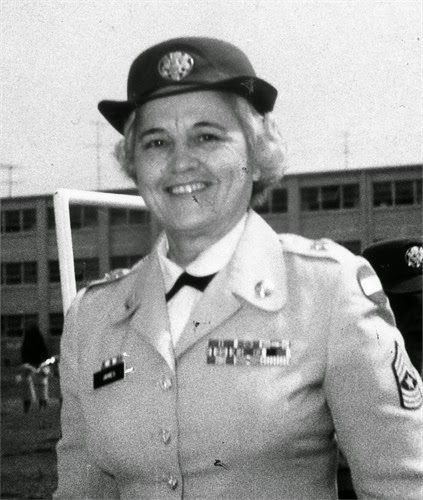
CAROLYN JAMES - TOP SECRETARY OF THE ARMY


The Top Secretary of the Army

Carolyn James, of Adrian, Georgia, wasn't the first woman to join the Women's Army Corps during World War II, nor was she the first Georgian out of the some 150,000 women who volunteered to help the war effort in uniform.  But it was this patriotic granddaughter of the founder of Adrian, who made U.S. Military history twice in her 20-year career.

Carolyn Hauser James, a daughter of Thomas Jefferson James II and Inez E. Hauser, was born in Adrian, Georgia on January 21, 1910.  Her grandfather, Thomas J. "Capt. T.J." James, founded the town of Adrian in the 1890s as a base for his railroad, the Wadley & Mt. Vernon, and his massive farming interests.  Not long after her grandfather's death, the James family fell on hard times.  During the years before the Great Depression, Miss James and her family moved to the Miami-Dade County area, where Carolyn took a job as a stenographer in a law office and later in a hotel.
As a divorced mother of a son James Richard Owen, 14, Carolyn decided it was time for her to join the war effort officially.  So at the age of 35, Carolyn enlisted in the Women's Army Corps on March 23, 1945 in Miami.  In the late 1940s, Carolyn worked at Oliver General Hospital in Augusta, Georgia.
The Women's Army Corps provided valuable service to the Army in times of war and peace.  General Douglas MacArthur proclaimed that the WACs "are my best soldiers."  The general added, "They work harder, complain less, and were better disciplined than men." Gen. Dwight D. Eisenhower said, "their contributions in efficiency, skill, spirit, and determination are immeasurable."

As the country returned to war in 1950 in Korea, Carolyn and other stenographers saw an increased work load.  Carolyn was assigned to Tokyo, where she was given the task of devising a system to organize and file correspondence related to the truce meetings which were held in hopes of ending the war quickly.

In her position as administrative assistant to the G-1, Carolyn received the Brown Star Medal for meritorious service to the Far East Command headquarters.  The citation for the medal read in part," for devising an ingenious system of processing and filing high priority correspondence and expedient cross-indexing providing a chronological history relevant to the cease-fire armistice negotiations in Korea."

In the week before Christmas, 1952, James' meritorious achievements led her assignment by General James A. Van Fleet to his 8th Army headquarters in Korea.   Master Sergeant James, the first ever master sergeant in the United States  Women's Army Corps, was joined by Corporal Louise M. Farrell, of Billings, Montana as the first two members of the WACs to be permanently assigned to duty in Korea.

Carolyn James once told her family friends  that while in Korea, she was scheduled to receive the Bronze Star from General of the Army Douglas MacArthur.  She related that she wore her best uniform to headquarters.  Just as she was to enter the building, however, a bird left its droppings all over her uniform, leaving her with a dilemma - see the General in that state, or go back and change and risk being late.  She chose the former, which is perhaps why I never saw a photo of the ceremony, although her uniform blouse shows she wore the medal.

Carolyn, in a January 1953 letter to her cousins, Anne Laura Hauser and Melville Schmidt ,  wrote, "I was transferred to Korea on 18 December, after the Far East Command had made a thorough search for a WAC to fill the position of personal secretary to General Van Fleet, and finally decided I had the desired qualifications - although my tour was about up.  However, when they approached me, I volunteered to extend for six months.  Since there are no other WACs in Korea, Eighth Army recommended that I bring another for company, so I chose a girl who had court reporting experience.  We had the honor of being the first two WACs to ever be permanently assigned to Korea's combat area." 

"Of course, everything considered,  Public Information Office and the other publicity media decided it was good material for WAC recruiting purposes, so for one week prior to our departure, we were constantly being photographed - motion and still; televised, and radio interviewed   Then we were flown over in a special mission B-17, " James continued.

"We were cordially received by all in headquarters here.  They have really done everything to make us comfortable and happy.  We're billeted in a senior officers' billets , which had a portion of the second floor allotted to female personnel - Red Cross workers, the Chief Nurse of the Eighth Army, and us.  We eat our meals here in headquarters in a little spot right outside the kitchen of the Army Commander's mess," the revered sergeant said. 

Sergeant James stated, "My duty hours are quite long -- from 0800 to 2100 and sometimes 2200 (9:00 and 10:00) at night.  However, movements are so restricted and the working conditions are so pleasant, it isn't too bad.  We have a little Korean house girl who takes care of our clothes, which gives us added freedom from outside chores."

With fond remembrances, the Adrian native recorded, "I have certainly enjoyed my short tenure as General Van Fleet's secretary, for he is without doubt one of the finest men I have ever had the privilege of knowing.  He is a superior field commander, American and humanitarian, and is respected and admired by everyone - Koreans included." 

In summarizing her war experience, Sergeant James stated, "The devastation and misery in this country as the result of this war is indeed heart-rending, but there is much evidence that our government and its people are doing everything possible to alleviate much of the suffering.  Aside from the many government-sponsored welfare organizations, every military unit (including the front-line units) has its own welfare program in the form of aid to orphanages, hospitals, etc.  It certainly increases one's pride in his country and its people to see such a genuine display of generosity toward those less fortunate." 

Carolyn's time in Korea was short as an armistice was signed on July 27, 1953, although a 1963 Colorado Springs Gazette article stated that M. Sgt. James has gone to Korea six months before hostilities began in 1950. 

James was assigned as Chief Clerk of the General Staff office at  ARADCOM Headquarters in Colorado Springs, Colorado in the summer of 1956.  In her seventh and last year at ARADCOM, James served as Administrative Officer of the Training Branch, G-3.

With the passage of The Military Pay Bill of 1958, Congress added pay grades of E-8 and E-9. With the new law in effect.  Carolyn H. James became the first in the Women's Army Corps (WAC) promoted to grade E-8, making her the first WAC promoted to master sergeant (or first sergeant).  It was during her tenure in Colorado Springs when Master Sgt. James was promoted to Sergeant Major (E-9) making her the first woman in the history of the United States Army to hold that esteemed enlisted man's rank.  

In 1963, Sergeant Major James was awarded an Oak Leaf Cluster in lieu of a second Army Commendation Medal.  She was assigned to the Women's Army Corps School at Fort McClellan, Alabama.  A second Oak Leaf Cluster was awarded to before her April 1965 retirement ceremony.   

Carolyn James lived for nearly two and one half decades in Colorado Springs following her retiriement after twenty years of service to the Army.   Sergeant Major James died on May 8, 1991 in local hospice.  

And thus the story of the determined and patriotic lady from Adrian, Georgia, who grew up to serve the country as the top secretary in the Army. 

Sunday, January 11, 2015


THE LAST TRUE MEASURE OF DEVOTION


On a small sandy hill, behind an old country church, there lies the body of a fallen, nearly forgotten hero. His tombstone simply reads "Paul E. Sly, November 3, 1921 to January 8, 1945."  You don't know Paul Sly, but seventy years ago today, this 23-year-old, Evansville, Indiana-born, Florida-raised journeyman welder and 82nd Airborne paratrooper  gave the last full measure of devotion to protect the freedoms of his family and his country.  This is his story.

Paul's parents, Anzy and Thomas Benjamin Sly, in their senior years worked in a citrus cannery in the small Central Florida town of Davenport, Florida, where Paul  graduated high school.

Paul Sly was drafted into the army although military service ran in Sly's blood.  His grandfather, Samuel Sly, was most likely a member of the  58th Indiana Infantry, which fought in the Tennessee,  Chickamauga and the March to the Sea campaigns. 

Paul married Kate Johnson, daughter of Kelley and Bell Fort Johnson, in a simple ceremony held in the Baptist church in Orianna in mid June of 1940.  The couple lived for a while in the Johnson community around Pleasant Springs Baptist Church on the old Savannah Road in eastern Laurens County.  

With a wife to support, Paul Sly took a job in the Carolinas as a welder.    In June of 1943, he was ordered to report for a physical at Carolina Beach, North Carolina.  By mid-October, Sly returned to Winter Park, Florida for his induction into the U.S. Army.  "If you want to make more money, join the paratroopers," the sergeant said.  It was extremely dangerous duty, but Paul had a family to support according to his son, Paul, Jr., who was born in July 1944, just as his father was arriving in Europe. 

Paul Sly (lower left corner) endured rigorous training assignments, achieving parachutist status on May 13, 1944. As a member of the famed 505th Infantry Regiment of the 82nd Airborne Division, Sly's status as a parachutist came too late to allow him to participate in the pre-dawn jump into Normandy on D-Day.

The 505th Infantry regiment, activated in 1942, participated in the campaigns of Sicily, Salerno, Normandy, the Netherlands and the Battle of the Bulge during World War II, during which the regiment received two Presidential Unit Citations, three foreign distinguished unit citations, the French fourragère, the Netherlands Military Order of William, and the Belgium fourragère. 

Sly joined the 82nd in July 1944 in France.  In September 1944, the unit participated in Operation Market Garden.  In December, the 505th jumped into an area which would host one of the war's most notorious and deadliest battles of World War II, the Battle of the Bulge. 

Just after New Years Day of 1945, Sly's battalion was assigned to occupy and move south out from the village of Reharmont in Southeast Belgium in the center of the regiment's attack.  Under intense 88 mm artillery, mortar and small arms fire, Sly's Company C  incurred heavy casualties as it moved out from the woods  north of Reharmont. 

"They had fields of fire - it became obvious to us early on that nobody was going to cross that open ground in daylight without tank or artillery support, so we fell back into the woods and started screaming for artillery fire and tank support, and neither were forthcoming," Sgt. Elmo Bell of C Company recalled.   

Finally, C Company was ordered to move forward to the edge of the woods for the assault on the town, which eventually succeeded, but with great loss of life reducing the company down to half of its normal strength.  

"Your husband was wounded in Belgium by the explosion of an enemy shell while he was engaged in delivering a mesage from the commander of his organization.  That was on January 4, 1945," later wrote Major General James Gavin in a letter to Kate Sly.  

The first telegraphic notice came on January 25,: "Regret to inform you your husband Paul E. Sly was seriously wounded in action, 4 January 1945 in Belgium, J.A.  Ulio."

The final and devastating notice soon followed that Pvt. Paul E. Sly died from his wounds on January 8, 1945. 

Following Private Sly's death, letters poured in from military and political officials. "The significance of his heroic service to his country will be preserved and commemorated by a grateful nation.  It is hoped that this thought may give you strength and courage in your sorrows," wrote Major General J.A. Julio, Adjutant General, United States Army, January 28, 1945

Secretary of War Henry L. Stemson added,  "The loss of a loved one is beyond man's repairing, and the medal is of slight value; not so. However, the message it carries is we are all comrades in arms in this battle for our country and those who have gone are not, and  never will be forgotten by those of us who remain." 

Major General James M. Gavin, the youngest major general division commander in the Army in World War II and who jumped with his own men,  said, "Private Sly was a loyal and well disciplined soldier who had developed a high sense of loyalty.  His humor was a great morale builder and consequently he was liked by his comrades."  
"Putting aside family ties, the admiration, respect and affection of comrades are a soldier's most priceless possessions.  These possessions I believe your son had earned in full measure.  Death of such a man leaves each member of the division a lasting sense of loss, from which there comes to you a deep sense of personal sympathy,"  continued General Gavin in his letter of February 23, 1945. 

Chaplain Philip M.  Hannan in comforting Sly's widow wrote, "From the account of those who were near him when he met his death, your son was hit by a shell fragment and died very shortly thereafter.  His death occurred in Belgium.  The greatest courage and devotion of men like your son has made possible the truly epic history and accomplishments of this regiment, you can be justly proud of him as a loyal soldier and Catholic.  

"Although your son has been with this regiment for quite some time, he was well respected and had won the friendship and goodwill of all of his comrades.  During the campaign in which he met his death and in previous engagements, Paul Sly was noted for his aggressiveness.  His officers testified that he was a very good soldier and always ready to take the worst with a smile," Chaplain Hannan said. 

The Chaplain assured Mrs. Sly that her husband did have the comfort and aid of his religion at the time of his death and all during the bitterest winter weather that the Catholic men continued to attend Mass and to receive general absolution, even in the deep snow drifts.  

Atlanta Constitution owner, Clark Howell, wrote, "There are no words which serve to alleviate your sorrow, but I did want to send you my sincere sympathy." Standard letters from future governor of Georgia and then  Adjutant General S. Marvin Griffin and Georgia Governor Ellis Arnall came to Mrs. Sly's mail box in March. 

 "Your son was buried in Belgium and I can assure you that this was accomplished in a most befitting manner by his comrades with an Army Chaplain officiating," wrote General Gavin in a most personal letter.  For more than two and one half years his body laid in the United States Military Cemetery Henri Chapelle, Belgium, Grave No. 167, Row 9, Plot No. VV.

In November 1947, one by one, 6250 coffins, containing the remains of Private Sly and other servicemen who died in Europe, were unloaded from the hold of the USS Joseph Connolly in New York Harbor.  New York Mayor William O'Dwyer,  who presided over the ceremonies, wrote Kate Sly, "As mayor of New York and on behalf of the citizens of this city, I extend my heartfelt sympathy to the family of Pvt. Paul E. Sly, who so honorably gave his life that others might enjoy peace and freedom. I trust and pray his sacrifice will not have been in vain."

Included aboard the shipment of fallen heroes were the bodies of T Sgt. Emmett Asbell, S. Sgt. Palmer N. Braddy, 2nd Lt. Blakely Parrott, and T-4 Johnny Rowland of Dublin.  Six thousand marchers escorted the bodies up Fifth Avenue and the Hero's Canyon.  This time, there was no ticker tapes thrown out of windows nor were there any  cheers yelled from the skyscrapers. Only the mourning sound of  mothers' tears of  anguish and the muffled respectful drumbeats could be heard as they reverberated through what is still called "The Canyon of Heroes."  

It was late in the cool, cloudy afternoon of  the third Thursday of November 1947, when the body of Private Paul Edward Sly was finally laid to rest in the cemetery of Pleasant Springs Baptist Church in southeastern Laurens County.  Gill C. Dudley had accompanied Sly's body on  the last final leg of his journey home.  Memories of that mournful day are still vivid in Paul Sly Jr.'s mind.  Members of the local unit of the VFW served as pallbearers in a ceremony presided over by V.A. Chaplain, W.J. Willingham. 

Kate Sly lovingly kept the memories of her husband's service and his death. If you close your eyes and turn on your other senses you can still feel the love and smell her perfume in the brittle, yellowing  pages of her chocolate brown scrapbook.  

And now, on this 70th anniversary of Paul Sly's last true measure of devotion, it is only proper and fitting for our community to recognize his acts of heroism.  On December 6, 1947, Kate J. Sly signed OQMG Form # 623 in applying for a military headstone for her husband, Serial No. 34795788 .  
A small marker was placed on his grave, but that marker is now missing.   Through the aid of Paul Sly, Jr. and  the  Laurens County Historical Society, there will be an appropriate marker which tells the true identity of this never to be forgotten hero, "Private Paul E. Sly, Co. C, 505th Infantry Regiment, 82nd Airborne Division, United States Army, World War II."