Tuesday, March 10, 2015

CAROLYN JAMES - TOP SECRETARY OF THE ARMY


The Top Secretary of the Army
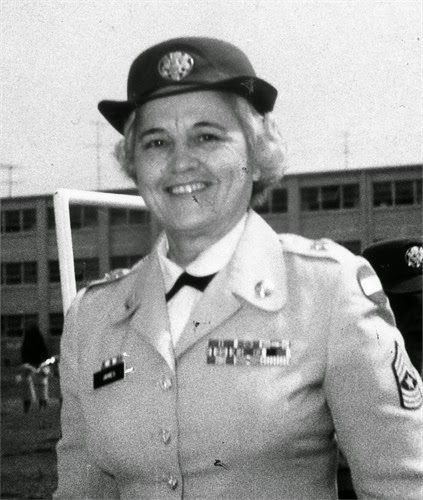
Carolyn James, of Adrian, Georgia, wasn't the first woman to join the Women's Army Corps during World War II, nor was she the first Georgian out of the some 150,000 women who volunteered to help the war effort in uniform.  But it was this patriotic granddaughter of the founder of Adrian, who made U.S. Military history twice in her 20-year career.

Carolyn Hauser James, a daughter of Thomas Jefferson James II and Inez E. Hauser, was born in Adrian, Georgia on January 21, 1910.  Her grandfather, Thomas J. "Capt. T.J." James, founded the town of Adrian in the 1890s as a base for his railroad, the Wadley & Mt. Vernon, and his massive farming interests.  Not long after her grandfather's death, the James family fell on hard times.  During the years before the Great Depression, Miss James and her family moved to the Miami-Dade County area, where Carolyn took a job as a stenographer in a law office and later in a hotel.
As a divorced mother of a son James Richard Owen, 14, Carolyn decided it was time for her to join the war effort officially.  So at the age of 35, Carolyn enlisted in the Women's Army Corps on March 23, 1945 in Miami.  In the late 1940s, Carolyn worked at Oliver General Hospital in Augusta, Georgia.
The Women's Army Corps provided valuable service to the Army in times of war and peace.  General Douglas MacArthur proclaimed that the WACs "are my best soldiers."  The general added, "They work harder, complain less, and were better disciplined than men." Gen. Dwight D. Eisenhower said, "their contributions in efficiency, skill, spirit, and determination are immeasurable."

As the country returned to war in 1950 in Korea, Carolyn and other stenographers saw an increased work load.  Carolyn was assigned to Tokyo, where she was given the task of devising a system to organize and file correspondence related to the truce meetings which were held in hopes of ending the war quickly.

In her position as administrative assistant to the G-1, Carolyn received the Brown Star Medal for meritorious service to the Far East Command headquarters.  The citation for the medal read in part," for devising an ingenious system of processing and filing high priority correspondence and expedient cross-indexing providing a chronological history relevant to the cease-fire armistice negotiations in Korea."

In the week before Christmas, 1952, James' meritorious achievements led her assignment by General James A. Van Fleet to his 8th Army headquarters in Korea.   Master Sergeant James, the first ever master sergeant in the United States  Women's Army Corps, was joined by Corporal Louise M. Farrell, of Billings, Montana as the first two members of the WACs to be permanently assigned to duty in Korea.

Carolyn James once told her family friends  that while in Korea, she was scheduled to receive the Bronze Star from General of the Army Douglas MacArthur.  She related that she wore her best uniform to headquarters.  Just as she was to enter the building, however, a bird left its droppings all over her uniform, leaving her with a dilemma - see the General in that state, or go back and change and risk being late.  She chose the former, which is perhaps why I never saw a photo of the ceremony, although her uniform blouse shows she wore the medal.

Carolyn, in a January 1953 letter to her cousins, Anne Laura Hauser and Melville Schmidt ,  wrote, "I was transferred to Korea on 18 December, after the Far East Command had made a thorough search for a WAC to fill the position of personal secretary to General Van Fleet, and finally decided I had the desired qualifications - although my tour was about up.  However, when they approached me, I volunteered to extend for six months.  Since there are no other WACs in Korea, Eighth Army recommended that I bring another for company, so I chose a girl who had court reporting experience.  We had the honor of being the first two WACs to ever be permanently assigned to Korea's combat area." 

"Of course, everything considered,  Public Information Office and the other publicity media decided it was good material for WAC recruiting purposes, so for one week prior to our departure, we were constantly being photographed - motion and still; televised, and radio interviewed   Then we were flown over in a special mission B-17, " James continued.

"We were cordially received by all in headquarters here.  They have really done everything to make us comfortable and happy.  We're billeted in a senior officers' billets , which had a portion of the second floor allotted to female personnel - Red Cross workers, the Chief Nurse of the Eighth Army, and us.  We eat our meals here in headquarters in a little spot right outside the kitchen of the Army Commander's mess," the revered sergeant said. 

Sergeant James stated, "My duty hours are quite long -- from 0800 to 2100 and sometimes 2200 (9:00 and 10:00) at night.  However, movements are so restricted and the working conditions are so pleasant, it isn't too bad.  We have a little Korean house girl who takes care of our clothes, which gives us added freedom from outside chores."

With fond remembrances, the Adrian native recorded, "I have certainly enjoyed my short tenure as General Van Fleet's secretary, for he is without doubt one of the finest men I have ever had the privilege of knowing.  He is a superior field commander, American and humanitarian, and is respected and admired by everyone - Koreans included." 

In summarizing her war experience, Sergeant James stated, "The devastation and misery in this country as the result of this war is indeed heart-rending, but there is much evidence that our government and its people are doing everything possible to alleviate much of the suffering.  Aside from the many government-sponsored welfare organizations, every military unit (including the front-line units) has its own welfare program in the form of aid to orphanages, hospitals, etc.  It certainly increases one's pride in his country and its people to see such a genuine display of generosity toward those less fortunate." 

Carolyn's time in Korea was short as an armistice was signed on July 27, 1953, although a 1963 Colorado Springs Gazette article stated that M. Sgt. James has gone to Korea six months before hostilities began in 1950. 

James was assigned as Chief Clerk of the General Staff office at  ARADCOM Headquarters in Colorado Springs, Colorado in the summer of 1956.  In her seventh and last year at ARADCOM, James served as Administrative Officer of the Training Branch, G-3.

With the passage of The Military Pay Bill of 1958, Congress added pay grades of E-8 and E-9. With the new law in effect.  Carolyn H. James became the first in the Women's Army Corps (WAC) promoted to grade E-8, making her the first WAC promoted to master sergeant (or first sergeant).  It was during her tenure in Colorado Springs when Master Sgt. James was promoted to Sergeant Major (E-9) making her the first woman in the history of the United States Army to hold that esteemed enlisted man's rank.  

In 1963, Sergeant Major James was awarded an Oak Leaf Cluster in lieu of a second Army Commendation Medal.  She was assigned to the Women's Army Corps School at Fort McClellan, Alabama.  A second Oak Leaf Cluster was awarded to before her April 1965 retirement ceremony.   

Carolyn James lived for nearly two and one half decades in Colorado Springs following her retiriement after twenty years of service to the Army.   Sergeant Major James died on May 8, 1991 in local hospice.  

And thus the story of the determined and patriotic lady from Adrian, Georgia, who grew up to serve the country as the top secretary in the Army. 

Sunday, January 11, 2015


THE LAST TRUE MEASURE OF DEVOTION


On a small sandy hill, behind an old country church, there lies the body of a fallen, nearly forgotten hero. His tombstone simply reads "Paul E. Sly, November 3, 1921 to January 8, 1945."  You don't know Paul Sly, but seventy years ago today, this 23-year-old, Evansville, Indiana-born, Florida-raised journeyman welder and 82nd Airborne paratrooper  gave the last full measure of devotion to protect the freedoms of his family and his country.  This is his story.

Paul's parents, Anzy and Thomas Benjamin Sly, in their senior years worked in a citrus cannery in the small Central Florida town of Davenport, Florida, where Paul  graduated high school.

Paul Sly was drafted into the army although military service ran in Sly's blood.  His grandfather, Samuel Sly, was most likely a member of the  58th Indiana Infantry, which fought in the Tennessee,  Chickamauga and the March to the Sea campaigns. 

Paul married Kate Johnson, daughter of Kelley and Bell Fort Johnson, in a simple ceremony held in the Baptist church in Orianna in mid June of 1940.  The couple lived for a while in the Johnson community around Pleasant Springs Baptist Church on the old Savannah Road in eastern Laurens County.  

With a wife to support, Paul Sly took a job in the Carolinas as a welder.    In June of 1943, he was ordered to report for a physical at Carolina Beach, North Carolina.  By mid-October, Sly returned to Winter Park, Florida for his induction into the U.S. Army.  "If you want to make more money, join the paratroopers," the sergeant said.  It was extremely dangerous duty, but Paul had a family to support according to his son, Paul, Jr., who was born in July 1944, just as his father was arriving in Europe. 

Paul Sly (lower left corner) endured rigorous training assignments, achieving parachutist status on May 13, 1944. As a member of the famed 505th Infantry Regiment of the 82nd Airborne Division, Sly's status as a parachutist came too late to allow him to participate in the pre-dawn jump into Normandy on D-Day.

The 505th Infantry regiment, activated in 1942, participated in the campaigns of Sicily, Salerno, Normandy, the Netherlands and the Battle of the Bulge during World War II, during which the regiment received two Presidential Unit Citations, three foreign distinguished unit citations, the French fourragère, the Netherlands Military Order of William, and the Belgium fourragère. 

Sly joined the 82nd in July 1944 in France.  In September 1944, the unit participated in Operation Market Garden.  In December, the 505th jumped into an area which would host one of the war's most notorious and deadliest battles of World War II, the Battle of the Bulge. 

Just after New Years Day of 1945, Sly's battalion was assigned to occupy and move south out from the village of Reharmont in Southeast Belgium in the center of the regiment's attack.  Under intense 88 mm artillery, mortar and small arms fire, Sly's Company C  incurred heavy casualties as it moved out from the woods  north of Reharmont. 

"They had fields of fire - it became obvious to us early on that nobody was going to cross that open ground in daylight without tank or artillery support, so we fell back into the woods and started screaming for artillery fire and tank support, and neither were forthcoming," Sgt. Elmo Bell of C Company recalled.   

Finally, C Company was ordered to move forward to the edge of the woods for the assault on the town, which eventually succeeded, but with great loss of life reducing the company down to half of its normal strength.  

"Your husband was wounded in Belgium by the explosion of an enemy shell while he was engaged in delivering a mesage from the commander of his organization.  That was on January 4, 1945," later wrote Major General James Gavin in a letter to Kate Sly.  

The first telegraphic notice came on January 25,: "Regret to inform you your husband Paul E. Sly was seriously wounded in action, 4 January 1945 in Belgium, J.A.  Ulio."

The final and devastating notice soon followed that Pvt. Paul E. Sly died from his wounds on January 8, 1945. 

Following Private Sly's death, letters poured in from military and political officials. "The significance of his heroic service to his country will be preserved and commemorated by a grateful nation.  It is hoped that this thought may give you strength and courage in your sorrows," wrote Major General J.A. Julio, Adjutant General, United States Army, January 28, 1945

Secretary of War Henry L. Stemson added,  "The loss of a loved one is beyond man's repairing, and the medal is of slight value; not so. However, the message it carries is we are all comrades in arms in this battle for our country and those who have gone are not, and  never will be forgotten by those of us who remain." 

Major General James M. Gavin, the youngest major general division commander in the Army in World War II and who jumped with his own men,  said, "Private Sly was a loyal and well disciplined soldier who had developed a high sense of loyalty.  His humor was a great morale builder and consequently he was liked by his comrades."  
"Putting aside family ties, the admiration, respect and affection of comrades are a soldier's most priceless possessions.  These possessions I believe your son had earned in full measure.  Death of such a man leaves each member of the division a lasting sense of loss, from which there comes to you a deep sense of personal sympathy,"  continued General Gavin in his letter of February 23, 1945. 

Chaplain Philip M.  Hannan in comforting Sly's widow wrote, "From the account of those who were near him when he met his death, your son was hit by a shell fragment and died very shortly thereafter.  His death occurred in Belgium.  The greatest courage and devotion of men like your son has made possible the truly epic history and accomplishments of this regiment, you can be justly proud of him as a loyal soldier and Catholic.  

"Although your son has been with this regiment for quite some time, he was well respected and had won the friendship and goodwill of all of his comrades.  During the campaign in which he met his death and in previous engagements, Paul Sly was noted for his aggressiveness.  His officers testified that he was a very good soldier and always ready to take the worst with a smile," Chaplain Hannan said. 

The Chaplain assured Mrs. Sly that her husband did have the comfort and aid of his religion at the time of his death and all during the bitterest winter weather that the Catholic men continued to attend Mass and to receive general absolution, even in the deep snow drifts.  

Atlanta Constitution owner, Clark Howell, wrote, "There are no words which serve to alleviate your sorrow, but I did want to send you my sincere sympathy." Standard letters from future governor of Georgia and then  Adjutant General S. Marvin Griffin and Georgia Governor Ellis Arnall came to Mrs. Sly's mail box in March. 

 "Your son was buried in Belgium and I can assure you that this was accomplished in a most befitting manner by his comrades with an Army Chaplain officiating," wrote General Gavin in a most personal letter.  For more than two and one half years his body laid in the United States Military Cemetery Henri Chapelle, Belgium, Grave No. 167, Row 9, Plot No. VV.

In November 1947, one by one, 6250 coffins, containing the remains of Private Sly and other servicemen who died in Europe, were unloaded from the hold of the USS Joseph Connolly in New York Harbor.  New York Mayor William O'Dwyer,  who presided over the ceremonies, wrote Kate Sly, "As mayor of New York and on behalf of the citizens of this city, I extend my heartfelt sympathy to the family of Pvt. Paul E. Sly, who so honorably gave his life that others might enjoy peace and freedom. I trust and pray his sacrifice will not have been in vain."

Included aboard the shipment of fallen heroes were the bodies of T Sgt. Emmett Asbell, S. Sgt. Palmer N. Braddy, 2nd Lt. Blakely Parrott, and T-4 Johnny Rowland of Dublin.  Six thousand marchers escorted the bodies up Fifth Avenue and the Hero's Canyon.  This time, there was no ticker tapes thrown out of windows nor were there any  cheers yelled from the skyscrapers. Only the mourning sound of  mothers' tears of  anguish and the muffled respectful drumbeats could be heard as they reverberated through what is still called "The Canyon of Heroes."  

It was late in the cool, cloudy afternoon of  the third Thursday of November 1947, when the body of Private Paul Edward Sly was finally laid to rest in the cemetery of Pleasant Springs Baptist Church in southeastern Laurens County.  Gill C. Dudley had accompanied Sly's body on  the last final leg of his journey home.  Memories of that mournful day are still vivid in Paul Sly Jr.'s mind.  Members of the local unit of the VFW served as pallbearers in a ceremony presided over by V.A. Chaplain, W.J. Willingham. 

Kate Sly lovingly kept the memories of her husband's service and his death. If you close your eyes and turn on your other senses you can still feel the love and smell her perfume in the brittle, yellowing  pages of her chocolate brown scrapbook.  

And now, on this 70th anniversary of Paul Sly's last true measure of devotion, it is only proper and fitting for our community to recognize his acts of heroism.  On December 6, 1947, Kate J. Sly signed OQMG Form # 623 in applying for a military headstone for her husband, Serial No. 34795788 .  
A small marker was placed on his grave, but that marker is now missing.   Through the aid of Paul Sly, Jr. and  the  Laurens County Historical Society, there will be an appropriate marker which tells the true identity of this never to be forgotten hero, "Private Paul E. Sly, Co. C, 505th Infantry Regiment, 82nd Airborne Division, United States Army, World War II."  

Saturday, November 22, 2014

WILLIAM WALLACE


WILLIAM WALLACE
“A True Survivor”

For the last fifteen years, millions of persons all over the world  have tuned their television sets to watch the popular television show Survivor.  The king of reality of shows features everyday people who endure the elements and undergo a variety of contests.  Sixty five years ago, William Wallace and thousands of other American soldiers and civilians faced the same challenge.  However, this challenge was real. It was constantly brutal,  frequently deadly and unfathomably heinous.

William Wallace, son of Lase and Frances Wallace, was born on April 1, 1922 and grew up in Millen, Georgia.  After his graduation from High School, William enlisted in the Army Air Corps and began his training at Fort McPherson in Atlanta.    Private Wallace was assigned to the 27th Bombardment Group (L)as a tail gunner.  The group was assigned to duty in the Philippine Islands in November 1941.  Wallace was at his station when the Japanese attacked the island chain on December 7.

The invaders launched a ferocious siege upon the American and Filipino forces, who had little food and an ever dwindling supply of ammunition.  After the three months of constant fighting, the American forces surrendered.  William was taken prisoner and along with thousands of other prisoners, was forced to endure the infamous “Bataan Death March.”  The weakened men were force-marched sixty miles in intense heat.  The only drinking water was found in mud puddles along the way.  Rest periods were rare.  Slow walkers were beaten.  Stragglers were bayoneted.  Six or seven hundred men were left dead on the side of the road.

After three months and fifteen hundred deaths at Camp O’Donnell, the prisoners were transported to the nefarious prison at Cabanatuan.  William remained there until September 1943.     It was in the latter months of 1943 that the Japanese government began to transport American prisoners back to the mainland to work in the coal mines.   Wallace and six hundred other prisoners were crammed into the hold a cargo ship, which set a course for Osaka.

Along the way, the ship detoured to Formosa in China.  The men were sent to a coal mine and were worked more than a half day, every day.  William was forced to push a heavy coal car up hill.  Any slip might result in a beating.    A prisoner’s daily diet consisted of three cups of rice.  If they were lucky, the men were given a prize morsel of meat, a pickled grasshopper, known to its consumer as a “Georgia Thumper.”

By 1944, William was assigned to a coal mine of the Rinko Coal Company in Japan. Conditions in the mine were unbearable.  The men were placed in an open building, left to face the brutal winters with virtually no shelter.  Each man was given old clothes to wear and a single blanket to keep them warm.  On the coldest of nights, six men would lie on one blanket and lie together, three with their heads on one end and three at the other end, with the five blankets on top.  At least the meals were better.   Stewed fish and boiled soybeans were added to the customary, but highly treasured, three daily cups of rice.   Once a week, the men got a bath.

Wallace described the winter of 1945 as the worst.  Snow falls ranged from three feet and more.  In order to avoid work and gain a stay in the hospital, Wallace would hold his breath and fall flat into the snow to make it appear that he had lost consciousness on six or seven occasions.  His captors never realized his ruse.  Had they done so, he would have been immediately executed on the spot.  “Getting out the snow, the freezing rain and still being allowed to eat was worth the risk,” said Wallace.   During that winter, William suffered from dysentery and double pneumonia and spent Easter Sunday, his 23rd birthday, in the hospital.

Conditions in the camp began to deteriorate rapidly.  The men began to steal food and cigarettes from each other, but were strongly disciplined if caught.  Distribution of food was scrutinized down to the pro rata bean and crumb of rice.

William was not released until the United States dropped atomic bombs on Hiroshima and Nagasaki.  When he left the coal mine, he weighed 87 pounds.  Constant hunger and debilitating malaria and beriberi nearly killed William.  Thousands of others who weren’t so lucky.  

In August 1945, William returned to the United States and entered a hospital in California.   When he arrived home,  he possessed six stitches in his head, a result of an unprovoked attack by a Japanese civilian with a large chunk of coal.   After a period of recuperation, William returned to Georgia.  Among the first to greet him was his high school sweetheart Mary Dickey.  The couple married in 1946, but William believed his obligation to his country was not yet completed.  He returned to the Army Air Corps for a three-year hitch.  Though he tried to live a normal life, the haunting memories of his incarceration prevented William from sleeping with a light off for more than eight years.  Talking about his experiences was difficult, if not impossible.  It wasn’t until the survivors held their first reunion when William began to relate the horrors of his internment.  Wallace’s  remembrances are featured in Donald Knox’s “Death March,” the story of the Bataan Death March and its survivors.

Wallace told Knox, “the further we went into captivity, the worse it became.”  He began to doubt whether or not he could ever survive, but came to realize “that the human body can suffer nearly everything and still survive.”

William Wallace graduated from Mercer University with a double major in religion and history.  For forty-one years, he served small rural Baptist churches in our area and worked at Warner Robins AFB until poor health forced his retirement in 1943.  His last sermon was delivered in 1991.

In January 1992, nearly fifty years after his capture,  William Wallace was presented the Congressional Prisoner of War Medal in his hospital bed by Congressman J. Roy Rowland.   Never bitter toward his captors, Wallace was disappointed that Japanese Americans interned in camps in our country were given a reparation of twenty thousand dollars, while he and the four thousand survivors and the families of the five thousand who died never received a cent of compensation.

The Rev. William Wallace died on February 27, 1995.  The lung disease he contracted in the camps eventually killed him.   Wallace survived one of the most brutal prison camps in the history of the world.  He endured to serve his fellow man and to espouse the word of the Gospel and spread the message of peace and love toward all mankind.  On this Memorial Day, take a moment to remember William Wallace and the millions of brave Americans who sacrificed their lives, their homes and families to preserve our freedoms.


Wednesday, November 19, 2014

THE TUSKEGEE AIRMEN OF LAURENS COUNTY


SOARING TO NEW HEIGHTS

Some 85 to 90 years ago, three young Laurens County boys played in the cotton fields and stared into the sky as their parents and the older members of their families picked cotton and other crops from the field.

Hardly any of them had ever seen an airplane in their young and isolated lives.  In the next two decades, each of them would not only learn what an airplane was, they would learn to fly some of the fastest airplanes in the U.S. Air Force.

Each of these three men took separate career paths.  One flew bomber planes, another fighter planes, and the last one flew jet planes higher and faster than few people had eve flown before.

On Veteran’s Day, the State of Georgia will honor these three men by naming the intersection of U.S. Highway 80 West and the U.S. Highway 441 By-pass as the Herndon Cummings, Marion Rodgers, John Whitehead Tuskegee Airmen Interchange.  

The legislation was sponsored by Representatives Matt Hatchett, Bubber Epps and Jimmy Pruett at the request of Laurens County Commissioner, Buddy Adams, who has been the driving force in honoring veterans in Laurens County since his election to office in 2008.   Adams proposed legislation to name the two legs of the by-pass for Lt. Kelso Horne,  the cover man of Life magazine’s first D-Day issue and Lt. Col. Clyde Stinson, who was awarded two Silver Stars for heroism and was one of the highest ranking officers killed in actual combat in Vietnam. 

     Of the estimated one thousand men who bore the title of a “Tuskegee Airmen,” three of these remarkable aviators can call Laurens County, Georgia home.  

One, Major Herndon Cummings, was a native of Laurens County, while two others, Col. John Whitehead and Col. Marion Rodgers spent portions of their childhood living in Laurens County.  The legacy of these three men lived well beyond their years as a separate unit of the United States Army Air Force.  Laurens County’s three Tuskegee Airmen went on to remarkable achievements in aviation for decades beyond their service during World War II.


   Herndon Cummings was born on April 25, 1919 in the Burgamy District of Laurens County, Georgia.  The son of Joseph and Mollie Hill Cummings,  Don’s interest in aviation was sparked on Christmas Day in 1928 when his father gave him a toy German zeppelin.  His interest in flying was forever sealed in 1936 when Don and his brother took a five-dollar ride  in a Ford Tri-Motor plane.  As the plane soared in the skies west of Dublin, Don underwent a life-altering experience.  "By the time the plane landed, I knew what I wanted to do," he recalled.   

     Cummings enlisted in the Air Corps on June 25, 1942.  He trained in the B-25 bomber at Tuskegee and later at Lockbourne Air Force Base in Columbus, Ohio, where he would later make his home.   Of the nine hundred to a thousand men who successfully completed their training at Tuskegee, most trained as fighter pilots in the P-51 fighter and other fighters. 

     Lt. Cummings was assigned to the 477th Bomber Group, which was based at Selfridge Army Air Field, Michigan in 1944.  Many of the members of the group were commanded by white officers, who according to some, favored white officers over the black officers.  Concerns over racial troubles in Detroit forced the group to move to Godman Field near Fort Knox, Kentucky.    By March 1945, the 477th was uprooted again and moved to Freemen Army Field at Seymour, Indiana.  

    The field at Freeman maintained two clubs, one for supervisors and one for trainees, but were defacto separated between blacks and whites.  In the early days of April 1945, the relationships between the commanding officers and the black pilots began to deteriorate rapidly.   On April 9, 1945, the day of the death of President Franklin D. Roosevelt, more than 100 of the airmen were arrested and placed in jail for twelve days until they were released by order of new President, Harry S. Truman.  

     Just weeks after they were freed,  Lt. Cummings was promoted to captain to command a bomber.  After completing his four-year stint in the Army Air Corps, Cummings served in the Air Force Reserve and attained the rank of major before retiring after twenty years of service.

     Cummings earned a commercial pilot's license, but never utilized it because there were virtually no opportunities for employment of black pilots.  He went to work laying bricks in order to support his family and send his two daughters to college.

In one of his last official reunions with his fellow Tuskegee airmen, Major Cummings was invited to sit on the stage during the inauguration of President Barack Obama.  He died some six months later on July 2, 2009.

Marion Rodgers was born in Detroit, Michigan  on September 23, 1921 and raised to about age eight in Dublin, Georgia until his family moved to New York.   Rodgers grew interested in aviation when a man in the neighborhoold began to restore a damaged bi-plane.  From that point forward, Rodgers would spend his free time going to airports watching plans take off and land.  

           Not immediately accepted into flight school at Tuskegee, Alabama, Rodgers was first assigned to an anti-aircraft artillery unit and the served a short term as a radio operator.  Eventually, Marion was accepted into flight school at Keesler Field.  In May 1943, I'm sent to Pre-Flight Training at Tuskegee Army Air Field.

Rodgers trained at Moten Field before returning to Tuskegee where he flew the Vultee BT-131 for the requisite 80 flight hours.  Promoted to the much more powerful AT-6, Marion earned his 2nd Lieutenant wings.

             After flying the P-40, P-39 and P-47, Marion was assigned to the 99th Fighter Squadron, the famous unit eternally known as the “Red Tails.”  In 69 combat missions Lt. Rodgers  flew 370 hours as am escort for B-17s and B-24s. 

After the war, Rodgers was eventually promoted to command the 99th Fighter Squadron “The Red Tails”  at Lockbourne Air Base.  In 1948, the Air Force was integrated under orders from President Harry S. Truman.  Col. Rodgers, a twenty-two-year veteran of the Air Force and a 17-year Civil Service worker, spent one year working for N.A.S.A. as a program manager on the mission of Apollo 13.  In technical circles, Rodgers was prominent in the development of electronics and communications procedures with N.O.R.A.D..

           After his retirement in 1983, Rodgers became known for his exceedingly kind contributions of his time  to public organizations in his home town. He also attended as many events honoring the Tuskegee Airmen whenever and wherever he could.   In his spare time, Rodgers spent many fun times with his wife Suzanne and engaging in his favorite hobby as an amateur radio operator.   

         Just a few weeks ago, Rodgers, 93 years old,  was treated to one more flight in a P-51 over Camarillo, California.  The flight in the fighter plane which turned the tide of the air war in Europe came nearly seventy years after his first flight.

Col. John Whitehead, known to his fellow pilots as “Mr. Death,” was born in Lawrenceville, Virginia in 1924.  Like Col. Rodgers, Whitehead spent several of the years of his youth in Laurens County.  Lt. Whitehead flew several missions over Europe in World War II.

Col. Whitehead was the Air Force’s first African-American test pilot.  Many of his hours in the air came while he was a pilot instructor for the Air Force in the 1950s.   A former President of the Tuskegee Airmen, Inc., Whitehead was given his nickname, not because he cheated death on many times, but because of his gaunt looking face, supposedly resembling that of a skull.
  
In his 30-year career, Col. Whitehead spent more than 9,500 hours in the air, with some 5000 of them coming in jet aircraft.  In January 1951, Whitehead was featured on the cover of Ebony magazine.  

After serving as a pilot in Vietnam and retiring from the military, Whitehead served as an instructor and Air Force Liaison at Boeing and  Northrop Aircraft.   

Whitehead was awarded the Distinguished Flying Cross with three oak leaf clusters,  the Air Medal with seven oak leaf clusters and numerous other citations and medals.   He was a man of firsts, the first African American to graduate from the U.S. Air Force Experimental Test Pilots School, the first African American to fly the B-47 bomber and the first African American to serve as an instructor of jet pilots.

THE FLY BOYS


Since the first biplane flew over the skies of Laurens County just about a century ago, our young men, and a few young women,  have dreamed of flying up and into the skies above us.   Many of these young men went on to serve in the Air Force during the wars of the 20th Century.  On this Veteran’s Day, let us salute the Fly Boys, the warriors in the skies.

The first glimpses of the flying machines came during fair and festival times when barnstorming pilots thrilled thousands of curious onlookers.  

The first Laurens County pilot was Corporal Walter Warren.  Warren, a member o the American Expeditionary Force, was the first American airmen to be wounded in World War I in early December 1917.

After World War I, flying became a national obsession.  It was in 1919, when Dublin, then one of the largest cities in the state,  became the destination of pilots around Georgia.  Recruiters out of Souther Field in Americus flew in and out of Dublin in hopes of getting some local boys in the seat of plane.

But it was in the 1930s, when interest in flying exploded.  The Dublin City Council established the first airport on the Phelps Place on Claxton Dairy Road in 1929.   Mayor T.E. Hightower urged that “Dublin be put on the air map of the United States Aeronautical Association as soon as possible.”  “All the world has taken wings and Dublin must take to the air, too, or be left behind,” Hightower added.   Another landing strip was on the west side of town on the E.T. Barnes place on the Macon Road.  This primitive landing strip, probably located near the Dublin Mall

The kids of Dublin formed a Junior Birdmen Club in February 1935.  Emory Beckham was elected the wing commander, while Jack Baggett was chosen as the club captain.  Billy Keith served as the secretary-treasurer.  Other members of the club were Earle Beckham, Luther Word, Owen Word and Jimmie Sanders.  The club, organized to promote an interest in aviation, was the only club between Macon and Savannah.

The enthusiasm of the Junior Birdmen inspired city officials to begin construction of a municipal airport two miles south of town on the Dublin-Eastman Highway south of  the present site of Mullis’ Junkyard.  With the support of Monson Barron, the city’s oldest aviation afficionado, Clafton Barron, and Ellison Pritchett, who had worked for Boeing, Lockheed, and Douglas, a four plane hangar was constructed on the site.  Local officials continued to push the Barnes site on Highway 80 West, as well as the Cullens site in East Dublin on Highway 80 East.  Neither of the three sites ever attained the status of a first class airport. 

By far, the greatest interest in flying came when the United States entered World War II. Robert Werden, Jr. loved to fly and was so anxious to fly planes in World War II that he joined the Royal Canadian Air Force.  When the United States declared war, he joined the Army Air Force, only to be shot down and killed in the early years of the war.  


Lt. Lucian Bob Shuler, a former Cadwell High School basketball coach, was an ace, having shot down seven  Japanese planes in combat.   Captain Shuler (LEFT)  was awarded eleven Distinguished Flying Crosses and twelve Air Medals.   Cpt. William A. Kelley, a former Dublin High School coach, was flying the “Dauntless Dotty” when  it crashed into the sea on June 6, 1945.  The B-29 Superfortress was the first B-29 to bomb Tokyo.  Kelley and his crew, who flew in a bomber named “The Lucky Irish,” were the first crew in the Pacific to complete 30 missions.  

Lt. Colonel J.R. Laney,  former residents of Dublin and graduates of West Point, was cited for their actions in India and Europe.   Laney was a member of the three-man crew of the Douglas XB-42 Mixmaster, the world’s fastest transcontinental plane, when it crashed into a Washington, D.C. suburb in December 1945.  Lt. Col. Laney survived the crash to complete a distinguished thirty-year career in the Army.   

Marion Rodgers,  (LEFT) who spent his early years in Dublin, was a squadron commander of the Tuskegee Airman in the years after World War II.  Major Herndon Cummings was a Tuskegee bomber pilot in the 477th Bomber Group. Cummings was incarcerated along with a hundred other fellow pilots for attempting to integrate an all-white officers club at Freeman Field in Indiana in 1945 in one of the country’s first major civil rights incidents. John Whitehead, who grew up in Dublin like Rodgers, was the Air Force’s first African American test pilot, was also a Tuskegee Airman. 


Major Herndon Cummings


 Col. John Whitehead


Captain Alvin A. Warren, Jr., of Cadwell, was awarded the Distinguished Flying Cross for flying 70 missions in the Indo-China Theater night and day through impassable mountain ranges and high clouds. Walter D. Warren, Jr. was a member of the famed Flying Tigers in China-Burma-India Theater.  Flight officer Emil E. Tindol also received the same award, just days before he was killed in action  while “flying the hump” - a term used for flying over the gigantic mountain ranges of India and Burma.    

For his battle wounds and other feats of courage and bravery, Lt. Clifford Jernigan was awarded the Purple Heart, an Air Medal and three Oak Leaf clusters in 1944.   Lt. Garrett Jones was a highly decorated pilot who participated in the first daylight bombings of Germany.   Lt. Col. Ezekiel W. Napier of Laurens County, a graduate of West Point, was awarded the Distinguished Flying Cross and retired from the Air Force in 1959 as a Brigadier General.  The "Pilot's Pilot," Bud Barron of Dublin, was credited with the second most number of air miles during the war, mainly by ferrying aircraft to and from the front lines. Barron has been inducted into the Georgia Aviation Hall of Fame.    

Near the end of the war, the U.S. Navy established an airport northwest of Dublin to support the Naval Hospital in Dublin.  That airport became the Laurens County Airport after the war.       Passenger and air freight service began in and out of Dublin in 1945 with flights on Southern Air Express Airlines.

J.P. McCullough was an aviation instructor in the Air Force.  Among his more famous pupils were two of the country’s better known aviators, United States Senators John Glenn and John McCain.

Major James F. Wilkes, (left) a Forward Air Controller flying a modified civilian Cessna airplane, was awarded a Silver Star for directing fighter aircraft in between friendly and enemy positions and saving the lives of many American soldiers.  Major Wilkes also won two Distinguished Flying Crosses and fifteen Air Medals. Lt. Col. Holman Edmond, Jr. in his two tours of duty in Vietnam was awarded 2 Bronze Stars and 17 Air Medals. 


Today, flying remains a popular pastime in Laurens County. And, still there are young men who fly missions for our country on a regular basis to preserve the freedoms e still enjoy at home and around the world. 


Lt. George Spicer


                                                                   Lt. Roy Malone


Monday, September 29, 2014

LAURENS COUNTIANS IN WORLD WAR II


A Brief History of Our Involvement


It was during the early morning hours of September 2, 1939, 75 years ago, while most Laurens Countians were still asleep that the British government declared war on Germany because of its unwarranted invasion of Poland.  World War II began.  Officially, the United States remained neutral.  Despite our country’s detached stance, locally Laurens County men continued training at the National Guard Armory in anticipation of the inevitable conflict. 

Dublin and Laurens County once again stepped forward and sent thousands of young men into military service during World War II.  Scores of Laurens County boys joined the National Guard, which was attached to the 121st U.S. Infantry division.   The Guard mobilized in September of 1940 into Federal service.  

Alta Mae Hammock and Brancy Horne were the first women to join the W.A.A.C..  Marayan Smith Harris was the first woman to join the WAVES.   Louise Dampier also served as a yeoman in the U.S. Navy.  Seaman Elbert Brunson, Jr. was onboard the U.S.S. Greer on September 4, 1941.  The destroyer was the first American destroyer to fire upon the dreaded German U-boat submarines in an incident which accelerated the country’s declaration of war against Germany.  Despite strong support from all the communities of Central Georgia and Cong. Carl Vinson,  the powerful chairman of the House Naval Affairs Committee, the federal government denied the location of a naval air training station on the Oconee River just below the city due to the lack of a large labor force and the heavy infestation of mosquitos in the area.  

Before the United States officially entered the war, Lester F. Graham, a Dublin marine, was among a thousand U.S. Marines assigned to protect American interests in Shanghai, China which was under attack by the Japanese army in the summer of 1937. 

Several Laurens Countians were at Pearl Harbor on December 7, 1941.  Marjorie Hobbs Wilson and her husband were eyewitnesses to the bombing.   Also at Pearl Harbor on the “Day of Infamy” were  George Dewey Senn, William Drew, Jr., Bascom Ashley, Walter Camp, Joel Wood, Harold Wright, Charles Durden, Hardy Blankenship, Rowland Ellis, Wade Jackson, Nathan Graham, Obie Cauley and Claxton Mullis.  Lts. William C. Thompson, Jr. and Everett Hicks were serving in the Philippines and Woody Dominy was stationed on Wake Island.   Mess Attendant 1st Class Albert Rozar served aboard the U.S.S. Gudgeon in the first submarine patrol into Japanese waters. 

Alton Hyram Scarborough, of the D.H.S. Class of '37, was the first of one hundred and nine casualties of the war.  Robert Werden, Jr. loved to fly and was so anxious to fly planes in World War II that he joined the Royal Canadian Air Force.  When the United States declared war, he joined the Army Air Force, only to be shot down and killed in the early years of the war.  

Capt. Bobbie E. Brown of Laurens County was awarded the Congressional Medal of Honor for his heroism in the assault on Crucifix Hill in Aachen, Germany.  Capt. Brown, a career non- commissioned officer, personally led the attack on German positions, killing over one hundred Germans and being wounded three times during the battle.  Capt. Brown was the first Georgian ever to be awarded the Medal of Honor, along with eight Purple Hearts and two Silver Stars.  At the end of the war, Captain Brown was the oldest company commander in the United States Army and first in length of service.  Paratrooper Kelso Horne was pictured on the cover of Life during the invasion of Normandy.   Lt. Horne, a member of the famed 82nd Airborne Division and one of the oldest paratroopers in the U.S. Army, parachuted behind German lines near St.  Mere Eglise in the night time hours before the amphibious invasion of Normandy on June 6, 1944.   Ensign Shelton Sutton, Jr., a native of Brewton and a former center for Georgia Tech, was killed while serving aboard the U.S.S. Juneau, along with the famous Sullivan brothers.   Nearly two years later in 1944,  the U.S. Navy commissioned the U.S.S. Sutton in his memory.  His teammate Aviator Wex Jordan,  an all-Southeastern guard for Georgia Tech in 1941 and Tech’s Most Valuable Player, was killed in an air accident while training in San Diego on Veteran’s Day in 1943.

Like the fictional Captain John Miller in “Saving Private Ryan,” Dublin and Laurens County teachers left the classroom to fight for their country.  Robert Colter, Jr., who had been teaching Vocational-Agricultural classes at Cadwell High School was killed on February 20, 1945 in Germany.  Captain Henry Will Jones, the Vocational - Agricultural teacher and football coach at Dexter High School and a paratrooper, was killed at Peleliu Island in the South Pacific in October 18, 1944.  In recognition of his exemplary valor, Capt. Jones was posthumously awarded the Silver Star.   Lt. Lucian Bob Shuler, a former Cadwell High School basketball coach, was an ace, having shot down seven  Japanese planes in combat.   Captain Shuler was awarded eleven Distinguished Flying Crosses and twelve Air Medals.   Cpt. William A. Kelley, a former Dublin High School coach, was flying the “Dauntless Dotty” when  it crashed into the sea on June 6, 1945.  The B-29 Superfortress was the first B-29 to bomb Tokyo.  Kelley and his crew, who flew in a bomber named “The Lucky Irish,” were the first crew in the Pacific to complete 30 missions.  They were returning home to headline the 7th War Bond Drive when the accident occurred.  Randall Robertson and James Hutchinson, both only a year or so out of Dublin High School, were killed several weeks apart on the same beach on Iwo Jima in 1945.  

Hubert Wilkes and Jack Thigpen survived the fatal attack on  the “U.S.S. Yorktown” at the Battle of Midway.    John L. Tyre volunteered for six months hazardous duty in southeast Asia in an outfit dubbed “Merrill’s Marauders.”  The Marauders, the first ground soldiers to see action in World War II, fought through jungles filled with Japanese soldiers, unbearable heat and slithering snakes.  Only one out six managed to make it all way through the war. 

Lt. Colonel James D. Barnett, Col. Charles Lifsey, Col. George T. Powers, III,  and Lt. Colonel J.R. Laney,  former residents of Dublin and graduates of West Point, were cited for their actions in India and Europe.   Laney was a member of the three-man crew of the Douglas XB-42 Mixmaster, the world’s fastest transcontinental plane, when it crashed into a Washington, D.C. suburb in December 1945.  Lt. Col. Laney survived the crash to complete a distinguished thirty year career in the Army.   

James Adams, Morton C. Mason, Wilkins Smith, Russell M. Daley, Gerald Anderson, Marshall Jones, Robert L. Horton, Loyest B. Chance, Needham Toler, William L. Padgett, Joseph E. Joiner, W.B. Tarpley, Owen Collins, Loy Jones, Thurston Veal, James B. Bryan, James T. Daniel, Cecil Wilkes and others  were surviving in P.O.W. camps in Germany, while Alton Watson, James W. Dominy, and Alton Jordan  were held prisoner by the Japanese.  Lt. Peter Fred Larsen, a prisoner of the Japanese army, was killed by American planes when being transported to the Japanese mainland in an unmarked freighter.  Future Dubliner Tommy Birdsong was digging coal in a Japanese coal mine when an atomic bomb near Nagasaki was dropped.  Earlier he survived the infamous "Bataan Death March."   Other future Dubliners who survived the Bataan Death March were William Wallace, A. Deas Coburn, and Felix Powell.   

      Commander Robert Braddy, a graduate of the United States Naval Academy,  was awarded the Navy Cross, our nation’s second highest honor for naval heroism,  for his actions in North Africa in November of 1942.  Rear Admiral Braddy retired from the service in 1951.  Captain William C. Thompson was awarded a Silver Star, two Gold Stars, a Navy Cross and a Bronze Star for his outstanding naval submarine service.  Captain Thompson was the executive officer aboard the submarine Bowfin, which was credited with sinking the second highest Japanese tonnage on a single war patrol.  Thompson was aboard the U.S.S. Sealion when it was struck by Japanese planes at Cavite, Philippines.  The submarine was the first American submarine to be lost in World War II.  Both men are buried in Arlington National Cemetery.  Captain Thompson’s  first cousin, Sgt. Lester Porter of Dublin, led the first invading forces over the Danube River in nearly two millennia.  Marine Corporal James W. Bedingfield, of Cadwell, was awarded a Silver Star by Admiral Chester Nimitz for conspicuous gallantry and intrepidity in action against the Japanese at Namur Island, Kwajalein Atoll, on February 6, 1944.   His kinsman, Capt. Walter H. Bedingfield, was awarded a Silver Star for heroism in setting up a field hospital in advance of American lines at Normandy on D-Day.   T. Sgt. Thurman W. Wyatt was awarded a Silver Star for heroism when he assumed command of his tank platoon following the wounding of the commander and guided it to safety.   Tech. Sgt. Luther Word  was awarded the Silver Star, the nation’s third highest award for heroism,  just prior to his being killed in action.  Lt. Paul Jimmy Scarboro was awarded a Silver Star for gallantry as a pilot of a Super Fortress in the Pacific Ocean. Sgt. Frank Zetterower was awarded the Silver Star for heroism when he was killed in action while trying to rescue wounded soldiers.

Captain Alvin A. Warren, Jr., of Cadwell, was awarded the Distinguished Flying Cross for flying 70 missions in the Indo-China Theater night and day through impassable mountain ranges and high clouds.  Walter D. Warren, Jr. was a member of the famed Flying Tigers in China-Burma-India Theater.  Flight officer Emil E. Tindol also received the same award, just days before he was killed in action  while “flying the hump” - a term used for flying over the gigantic mountain ranges of India and Burma.    For his battle wounds and other feats of courage and bravery, Lt. Clifford Jernigan was awarded the Purple Heart, an Air Medal and three Oak Leaf clusters in 1944.   Lt. Garrett Jones was a highly decorated pilot who participated in the first daylight bombings of Germany.  Calvert Hinton Arnold was promoted to Brigadier General in 1945.  Lt. Col. Ezekiel W. Napier of Laurens County, a graduate of West Point, was awarded the Distinguished Flying Cross and retired from the Air Force in 1959 as a Brigadier General.  The "Pilot's Pilot," Bud Barron of Dublin, was credited with the second most number of air miles during the war, mainly by ferrying aircraft to and from the front lines. Barron has been inducted into the Georgia Aviation Hall of Fame.    Dublin native Lt. William L. Sheftall, Jr. flew 74 missions in Italy and was awarded the Silver Star for heroism.  Sidney Augustus Scott, the Chief Engineer of the  SS Charles Morgan, was awarded the Merchant Marine Meritorious  Service medal for his heroism in the landing of men and material on the beaches of Normandy just after D-Day. 

PFC Wesley Hodges was a member of the 38th Mechanized Calvary Recon Squad, the first American squad to enter Paris on August 25, 1944.   Seaman James T. Sutton survived the sinking  of the “U.S.S.  Frederick C. Davis,” the last American ship sunk by the German Navy.     The 121st Infantry of the Georgia National Guard, which was headquartered in Dublin until 1938 and of which Company K and 3rd Battalion HQ Co. were located in Dublin, won a Presidential Unit Citation for its outstanding performance of their duty in the Battle of Hurtgen Forest during Thanksgiving 1944.  Edward Towns was cited for his meritorious service to the submarine forces of the United States.  Curtis Beall, after being voted by his classmates as the most outstanding senior at the University of Georgia in 1943, joined his brother Millard in the United States Marine Corps.  Capt. John Barnett, a twenty-one-year-old Dubliner and twice a winner of the Bronze Star Medal for heroism, was credited with being the youngest executive officer in the United States Army in 1944.  Lt. Arlie W. Claxton won the Distinguished Flying Cross in 1943. These are only a few stories of the thousands of Laurens County's heroes of World War II.   Charles Yarborough and Reuben Whitfield were among the sailors who witnessed Japanese officials sign the official surrender agreement aboard the U.S.S. Missouri. 

Major Herndon “Don” M. Cummings was a bomber pilot in the 477th Bomber Group.  Though his unit was never saw active duty overseas, Major Cummings and his group were known as a group of units collectively called the “Tuskegee Airmen.”  Cummings was incarcerated along with a hundred other fellow pilots for attempting to integrate an all-white officers club at Freeman Field in Indiana in 1945.  Through the efforts of future Supreme Court justice Thurgood Marshall and the actions of a newly sworn President Harry Truman, the pilots were freed and later exonerated of all charges against them.  Cummings remained in the reserves for twenty years after his retirement from active duty.   He was awarded the Congressional Gold Medal by President George W.  Bush and was an honored guest at the inauguration of President Barack Obama. 

Two other Tuskegee Airman who were raised in Laurens County were Col. Marion Rodgers and Col. John Whitehead.    Col. Rodgers was a squadron commander of the 99th Fighter Squadron after the war.  Col. Whitehead was the first African American test pilot in the Air Force and was one of the few Tuskegee Airmen to fly in World War II, Korea and Vietnam.

Laurens Countians supported the war effort on the home front. A State Guard unit was formed by over-age and under-age men.  Everyone from school children to grandmothers did their part.  Many Laurens Countians commuted to Warner Robins and Macon to work for the war effort. Laurens Countians opened their homes to soldiers from Camp Wheeler, near Macon and British R.A.F. cadets from Cochran Field in Macon.    Angelo Catechis bought war bonds with his life's savings to help rescue  his family in Greece.   The women of Laurens County worked diligently on the home front.  The women made bandages, surgical dressings and sponges by the scores of thousands,  along with knitted garments.  Carolyn Hall, blind since birth, was one of the most proficient knitters in the community.  Laurens Countians contributed hundred of hours of time to the Red Cross, U.S.O. and numerous Civilian Defense programs. Bessye Parker Devereaux was the first woman in the Charleston, S.C. shipyards to be awarded the Outstanding Worksmanship Award by President Roosevelt.   In the summer of 1944, the U.S. government honored the citizens and Laurens County for their contributions to the war effort by naming one of the reconditioned "Liberty Ships" the "U.S.S. Laurens." 

When the final tallies were counted, one hundred and three Laurens Countians lost their lives during the deadliest war in the history of the world.  Many, many more were wounded.  Life here would never be the same.  In an ironic way, the war changed everything for the better.  Economic opportunities, with the establishment of the U.S. Naval Hospital and J.P. Stevens and the influx of thousands of new residents, catapulted the county into an economic boom which still continues day.